
Interview with Opal Palmer Adisa
When did you first realize that you are a painter or rather that you wanted to paint? [You might have realized that you were an artist earlier than you decided you wanted to be a painter]. When did you step fully into your painting/artist?
When I was a child, I liked to paint and draw. I’ve never considered myself a painter, and I still don’t because painters are so saturated with paint physically and mentally, they are purists. I’m not a purist, but I use traditional materials such as acrylic and watercolor in untraditional ways. But to answer your question, I started to paint when I was about seven. Even though I have been making art since childhood, I feel now I have fully stepped into being an artist. I understand the purpose, how to sustain the ability to create art, and why I cannot live without it.
Were you exposed to Art growing up and in what ways? Are there members in your immediate or extended family who are artists?
My mother ignited my artistic spark early on, guiding me to outline shapes and fill them with vibrant colors in kindergarten. She didn’t just tolerate my scribbles in the coloring book; she was not having it.
My mother’s love for art and culture was boundless. She took me to art museums like the Chicago Art Institute, where we marveled at masterpieces, and to galleries and to see public art, even the controversial pieces. She was a fan of independent films, dance, and all things cultural. I remember her turning to drawing and painting when stress crept in, a testament to her coping through creativity. Her interest in crafts, colors, and cultural events was infectious, and she instilled in me a curiosity to experience and appreciate different art forms.
How would you define your art and what is the dialogue that you are creating between yourself and audience?
My work examines the simultaneous reality of looking backward and being in the present. It’ s not only a social commentary but also a deeply personal journey through the colonization, assimilation, and disenfranchisement of my people in the Americas. It reflects the collective consciousness and shared memories of survivors, inviting viewers to empathize with our experience.
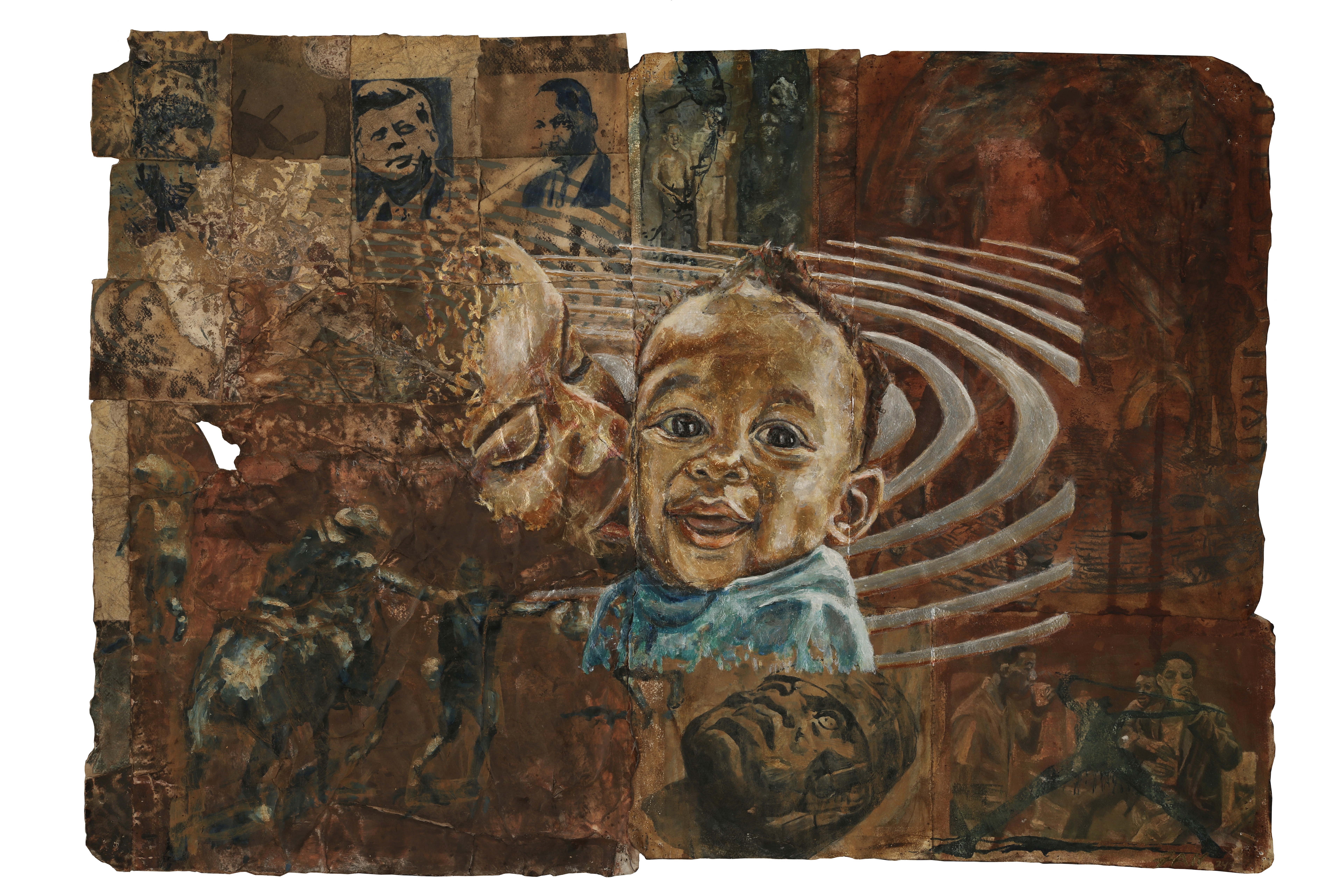
The works on paper consist of layered collages that incorporate narrative-based painted and drawn images. These fragmented images, along with racial and ancestral memories and current events, come together to form a distinct visual language.
My goal is to awaken memories in the viewer, encouraging you to think and feel through my work. I want to create an image that resonates with you and touches your soul. I am communicating with you visually in a unique way. You recognize what you are seeing, and now it’s time to reflect on how we are all connected.
Speak to me about your new work and the other works that you’re going to be doing? What has influenced/inspired these Madonna images, women painted gold… Are you in anyway countering the Aunt Jemima, black mammy stereotypical image portrayed in America.
My current series, The Black Madonna, features images inspired by the original dark mother, Isis, and the iconic Mammie figure holding a child.
The image of the enslaved person nurturing the white child has been a cultural taboo that is hard to forget. Yet, I was compelled to examine these images since it has been associated with some of the elders in my family.
The mammy, nursemaid, and bed-wench servant figure perched on the spiral of life appeared in my work in1999, and I’m still deeply engaged with a mixture of those images and symbols, demonstrating a continuous commitment to the exploration of these themes.
Yes, of course, I wanted to counter those explosive images and heal those old wounds that many black women and their children carry, aiming to empower and bring about positive change.
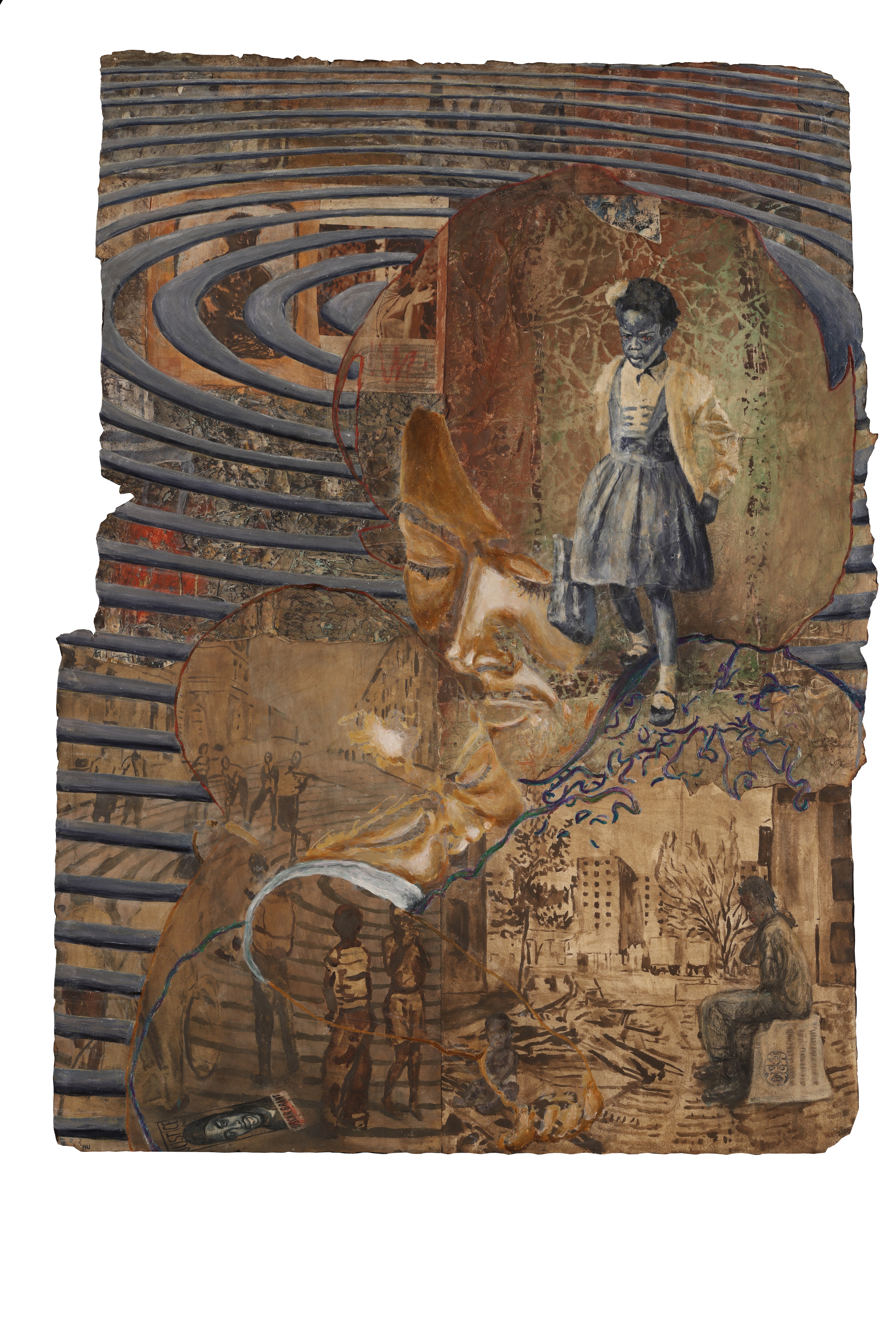
So, the Black Madonna series was created. Contemporized images of golden and copper black women lovingly holding their babies are layered over composed visual narratives. These narratives are carefully constructed to question societal opinions, using layered images, fragments of symbols, and current events to create a multi-dimensional and thought-provoking experience.
I see that you have a series about children, how did that come about and how does that fit into the larger body of your work?
The Legacy series came about from a visit to my mother in Chicago, who was sick. I stayed with her over the summer and watched a group of children hanging outside, or at least that’s how I perceived them. They were moving in a group, walking, talking, and a little playing, but nothing like I thought. I thought, wow, there is a group they could play games together, like how I grew up. It wasn’t until I went back to Oakland that I realized they were in a war zone infested with drugs, etc. I was behind a tall chain linked fence with locks surrounding my mother’s property, and I realized that they were surviving. They had to keep their little heads on a swivel and move as a group for their protection.

The Legacy series is a stark representation of the resilience of those surviving in Western culture, symbolized by my earlier work that depicted slave houses atop colonial tables, representing the colonized mind. The later images, showing children carrying guns and e-waste on their heads, serve as a powerful symbol of imperialism. The Legacy series captures the children of Chicago, navigating through drug-infested neighborhoods, a stark and urgent representation of gentrification. Yet, amidst these harsh realities, the series also incorporates symbols of transformation and historical images, offering hope in the face of adversity.
You’ve been doing a lot of reading, but you’ve done that throughout your career. However, as a result of specific readings you have decided and will and be embarking on a series about men. Why have you decided to take on the male persona and what is it that you’re trying to say about black men? Are your tackling or countering the stereotypical Black male as dangerous, hypersexual, a buffoon — all of those stereotypical images of black men being worthless and lazy and stupid…
I’m interested in showing the complexity of black men, how they are perceived, and how they are not any of the things that we have been programmed to believe or brainwashed to see, such as being aggressive or dangerous. I want to show how the perception is a lie and that black men are incredible, special, normal and complex humans. They are fascinating when comfortable and may allow you to see who they are. Black men are some of the most beautiful men physically, yet they are more than that. Just like black women are more than the Eurocentric opinion and the gaze, that often shapes our perceptions and judgments.
When you’re producing/doing your art, how does that make you feel, what is the atmosphere that you need to create? Do you listen to music; do you drink tea or do you just go into your studio and say I’m ready to work and begin?
I must calm my mind and make space for the work to develop.
For me, achieving a balanced state of mind and spirit is crucial when I step into my studio. Whether I’ve been away for a few days or haven’t had the necessary hours to reset, finding this equilibrium is key. However, when I’ve been working nonstop, it can feel like an addiction.
When I’m creating, I feel a profound sense of calm and connection. It’s as if I’m exactly where I’m supposed to be, at the right time. I’m stimulated, excited, and deeply connected to my work.
“I’m thinking, moving, and talking within the working progress. I start by sitting in my chair and having a discussion with whatever pieces I’m involved with. Sometimes I can listen to…”
Childhood memories, see the color, hear the sounds, and remember the feelings.”
Yes, I listen to music by Miles Davis, Roots, Mos Def, Faith Evans, Clark Sisters, Isaac Hays, Ramsey Lewis, Carmen McRae, Montserrat Caballe, Jessye Norman, and Leontyne Price, to name a few. I drink hard kombucha, water, tea, and sometimes juice.
To viewers and buyers of your work –what is it you want them to take away from seeing your work? Why should anyone purchase your work?
I want my Black Madonna’s to be a source of healing for the viewer, offering a comforting and soothing experience. The creation of my Black Madonna series was a personal journey of healing, a process that helped me mend my relationship with my mother. I aimed to infuse the mother’s love into each piece, fostering a sense of connection to personal history, memory, and an understanding of how many things are connected. As I matured, I transitioned from making socially polarized statements with color and content in my art to layering it with hope, love, and understanding.
I want to engage the viewer’s memory.
My work is collectible. I’m part of the one percent club. Only one percent of people who attend art school or a program continue to make art in their older adult life or make it a profession. My work is unique in its style and techniques, which involve a blend of traditional African American art forms and contemporary methods, and how the historical content is collaged in a narrative style.

My work also holds a significant place in the historical narrative of African American art, particularly since the Harlem Renaissance and the Great Migration. This is not just a historical connection, but a personal one, as I was also part of the Great Migration from Birmingham to Chicago. This personal connection adds a layer of authenticity and depth to my work, fostering a sense of belonging and connection for the audience.
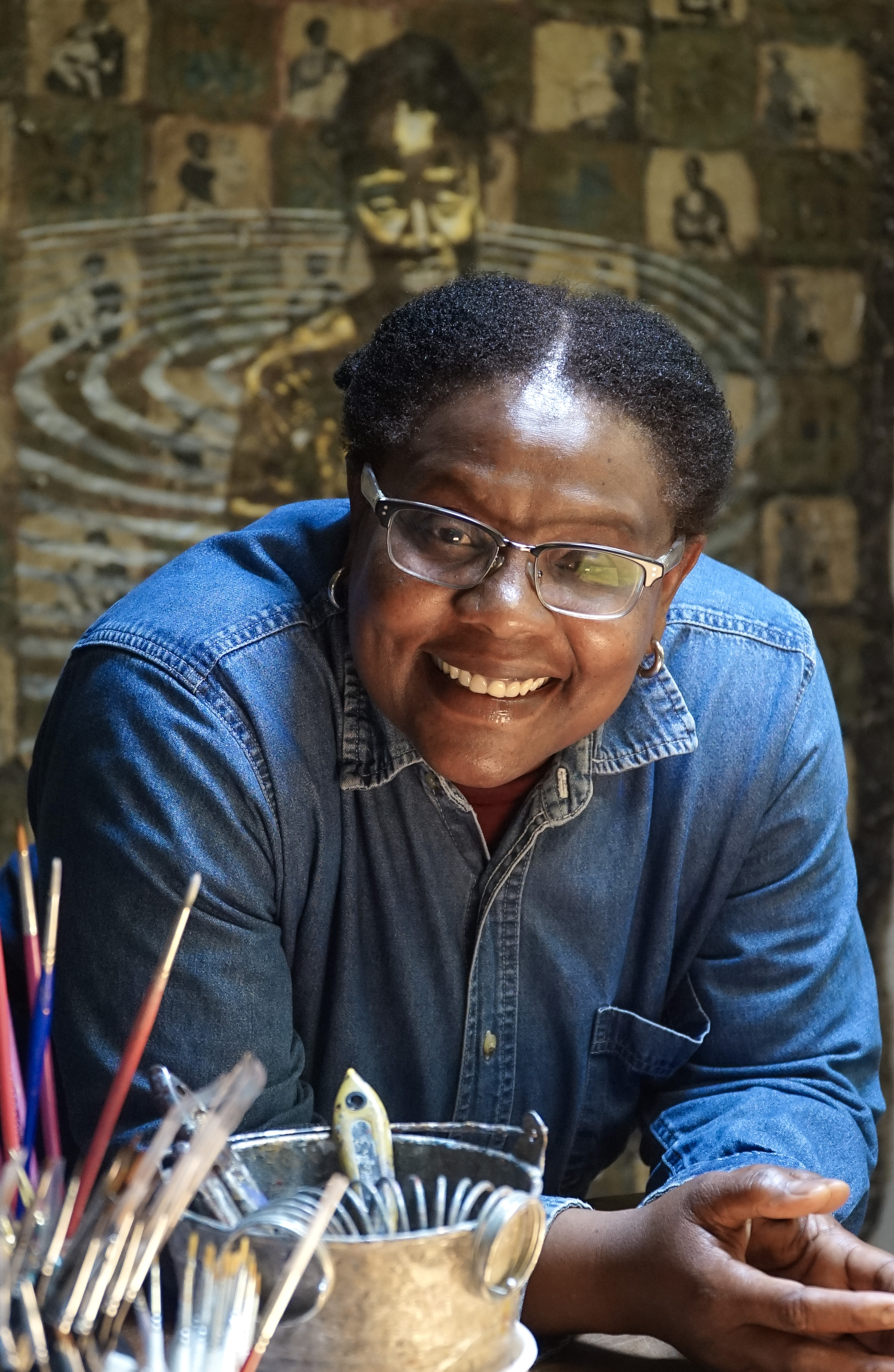
Fan Lee Warren, a contemporary African American artist, draws profound inspiration from her upbringing and education. Her birth in Birmingham, AL, and upbringing in Chicago, two culturally rich cities, have left an indelible mark on her art. Her creative boundaries expanded through her BFA from Illinois State University and an MFA from the School of the Art Institute, both of which have been instrumental in shaping her distinctive artistic voice. Her artworks grace several public collections, including the Neuberger Museum of Art in Purchase, New York, the New Harold Washington Library Center in Chicago, IL, the Alameda County Art Commission in Oakland, CA, and numerous private collections. Warren has received numerous grants, awards, and art commissions, and has been reviewed in various publications and catalogs.
For more information about the artist, visit her website:
 Opal Palmer Adisa