All posts by Opal Palmer Adisa

Opal Palmer Adisa is an exceptional writer/theatre director/photographer/gender advocate, nurtured on cane-sap and the oceanic breeze of Jamaica. Writer of poetry and professor, educator and cultural activist, Adisa has lectured and read her work throughout the United States, South Africa, Ghana, Nigeria, Germany, England and Prague, and has performed in Italy and Bosnia. An award-winning poet and prose writer Adisa has twenty four titles to her credit. Most recents are: Pretty Like Jamaica; The Storyteller's Return; Portia Dreams and 100 + Voices for Miss Lou. Other titles include the novel, It Begins With Tears (1997), which Rick Ayers proclaimed as one of the most motivational works for young adults. Love's Promise; 4-Headed Woman; Look a Moko Jumbie; Dance Quadrille and Play Quelbe; Painting Away Regrets; Until Judgement Comes;

Muhammad Ali: The Poet Boxer & Humanitarian

alithinkadisa

“I ain’t got no quarrel with them Viet Cong.” Muhammad Ali

I have never liked boxing, and have always believed and still do, that it should be outlawed. Having men or women beat on each other, while others watch and bet money seems barbaric, which is where the sport has its origin. The raw violence of boxing makes me shudder.

Nonetheless, when Muhammad Ali busted on the scene, his handsome face, his braggadocious manner, his poetic rhymes, his whole manner said he was a cut above the rest and I, like so many others, succumbed to his charisma and strong belief in himself. He was not just a boxer and a Muslim, he was a metaphysician. He understood keenly the law of attraction, how thinking and believing something are keys to making things happen.

Mostly what I admired about Ali was his sense of integrity, his willingness to put his life on the line, stymie his boxing career for his greater belief. When on April 28, 1967, in Huston, Ali decided to be a conscientious objector, and refused to be drafted into the U.S. army, his bold stance made many African Americans and other non-blacks proud. Ali dared to voice what many had been feeling and thinking, but were afraid to act upon. He spoke a truth America did not want to hear, not from a black man, not then, and not even now.

“Why should they ask me to put on a uniform and go 10,000

miles from home and drop bombs and bullets on brown

people in Vietnam while so-called Negro people in Louisville

are treated like dogs and denied simple human rights?”

Many remember Muhammad Ali as a great fighter, which he was, but I think Ali would like to be remembered as a great humanitarian, a man of principles. Ali kept faith with his heart even when it meant he was stripped of his heavy-weight title, and was banned from boxing for three years.

Muhammad Ali scored a gold medal at the 1960 Olympic Games in Rome. 

Muhammad Ali is the only fighter to be heavyweight champion three times.

Muhammad Ali danced like a buttlerfly in the ring and had the spirit and style of many lions.

May he continue to soar and soar and find rest among the ancestors.alifloatadisa


Bees Everywhere: Another Dream

I am sitting in my garden surrounded by a swarm of bees that are busy pollinating and not the least bit concerned about me. The colors are vibrant, it is a glorious day and I am feeling very much alive.

“A swarm of bees means happiness,” says the online dream book. Bring it on, I say.

When I was a little girl, I was called and thought of as a tom-boy because I had little to no interest in playing with dolls and sitting with my ankles crossed. I hung with the boys who were always going, playing antics, hurling themselves off buildings, getting into trouble. One of the troubles we got into involved our obsession in stoning beehives or using sticks to poke them, then running, hoping to out run them without getting stung.

Well this day we were not so lucky. William, Trevor and I discovered several bee hives at a neighbor’s house and we went and got long sticks to poke them. They were not pleased about our disturbance and came at us with great fury. William got stung on the face four times, which was swollen for almost a week, making him look like a monster. Trevor got stung so badly on his arm, he had to be taken to the doctor. I got stung on both buttocks, of all places and for a long time, whenever I sat it hurt. My mother was at work so the helper, alternated between rubbing the stings with crushed garlic and sliced onions. When Mommy came home she crushed guava leaves and rubbed the swollen area, then just before I went to bed she put baking soda paste on the swells and I slept on my stomach.

Bees pollinate a third of everything we eat and play a vital role in sustaining the planet’s ecosystems. Some 84% of the crops grown for human consumption – around 400 different types of plants – need bees and other insects to pollinate them to increase their yields and quality.

That was the first time I remember being stung, but certainly not the last time. Throughout my childhood I got stung, mostly by wasps, several times. I loved sugar cane, freshly cut, using my strong teeth to pull off the hard skin. During crop season the bees feasted on sugar cane. During mango season, the bees feasted on mangoes. Anything sweet, which was the sum total of all the things I loved, the bees feasted. I did not consider them friends. I did not know about the important job they performed. But I knew that they loved the same things I loved, including their byproduct, honey.

Swarming bees mean richness, gain and luck in many of the things you do. Seeing flying bees could mean troubles, but if the bees are flying around you, this foretells happiness, luck in love, and overcoming your difficulties.

Earlier this year, while putting out the garbage, I was stung by a bee. It was so unexpected. I managed to remove the sting with my fingernail but it still hurt and my upper arm was swollen for several days. I was upset with the bees because I have a deep appreciation and respect for them, and for years I have been making sure to plant flowers that they love. I know they are vital to our existence so I do my part to help them multiply. I always have sun-flowers, fennel and daisies in my garden.

To dream about humming bees in the process of collecting nectar is a sign of hope and promise. This could be a favorable time for your career, project or business to flourish because you would have better opportunities and more resources at your disposal than ever before. Success could be within reach.

There are sun-flowers blooming in my garden, my crotons are vibrant, my other succulents are pulsating, my herbs are thriving so when I dreamed that I was sitting happily in my garden in the midst of a swarm of bees, I was not surprised.

I am embarking on several new projects that have been incubating for over a decade, foremost of which is my children’s journal, Ay-Ay: Junior Caribbean Writer.

May the bees continue to ensure our food supply and indeed be a sign of my success in these ventures of love and career.images


A Lioness in My Study: My Dream

ilionessAdisa2015KAs I drove into my driveway I observed two, maybe three lioness, backs to me, feasting on a large animal. They were on a knoll on my property and, they were so engaging especially against the backdrop of the sun that was about to set.

I wanted to capture them so decided to go inside my study to get my camera.  I though what an amazing image!  I must share it with others.

I was neither afraid, nor did I think it odd that I live in St Croix where no lioness roam freely, and certainly not on my property. Nor did I think I should call someone for help. I mean, after all there were three lionesses on my property.

Calmly, with no sense of rush or panic I went inside to retrieve my camera, and somehow got distracted.  After a while, with camera dangling from my hand, I became aware that I was being observed. I looked towards my office door and there before me was the largest lioness and most beautiful creature I had ever seen.  Her head took up the entire width of my office door, and her eyes were gentle and comforting. I remember saying to myself, should I talk to her or should I hide? I sensed she was about to enter, and I quietly entered the inner camber of my room and watched as she used her paws and opened the door.

Should I photograph her or call for help, I thought.  I was sure she was not here to harm me.  In fact, I am certain she was harmless and only wanted to talk with me. I was awed by her largeness, beauty and gentleness.

That is the dream.

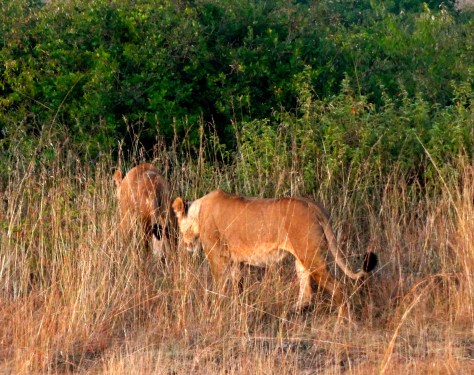
Backtrack to last July when I visited Kenya for the second time and went on a Safari.  It was a cold early morning; we left about 5 am as we were told the earlier we went, the more likely we were to see an abundance of animals, especially lions.  Although we had on sweater and jeans, July in Kenya is winter and can be very cold. In the pop-up roof jeep we were freezing, but thankfully our driver had blankets for us to drape ourselves. Among the numerous animals we saw, and I photographed were these lions, who were less than 20 feet away from us.  They did not appear to be ferocious killers.  They were having a normal day and we were, if anything, annoying, trying to get close to photograph them.

Of course, the lion has gained its killer reputation from experience, and I am sure if they were hungry and we stepped out of the jeep, they might have just decided to sample us for a meal.  But I have never feared them, and still don’t as my limited experience with them, including in dreams has always been one of spirit guides.

There are many interpretations that dream guides offer, so I have selected that which seems most fitting for my dream, and where I believe I am currently in my life.

Pride: Lions live in prides, and in dreams a lion can often mean pride. Is there anything in your waking life you are proud of?


Control/Power/Leadership: Lions often also known as the “king of the jungle” can also be a great symbol of control, power, and leadership.

 Strength: A lion in your dreams can symbolize your own strength. Strength can be physical, but often is emotional in our dreams.
If in a dream you see the sunset, it portends that soon you will finish your important work and you will start a completely different life.

I am so grateful for the lionesses that visited me and I pray they will continue to guide me as I embark on this new path.

2lionesses.adisa2015K


Broken Ankle: Learning From My Immobility

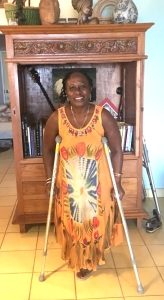
opalcrutchesI began walking because it is healthy, because one needs to keep fit when one gets to a certain age – well any age, because I have had stubborn middle-age excess weight that I have been trying to lose.

I have grown to like walking in the morning before the sun is too high and hot. I enjoy the clearing of my head that walking provides. I have come to enjoy walking by myself, to move at my own pace, to pause when I see a flower or an insect or a view, anything, even a dead frog or iguana that has been run over by a vehicle, to really see and not just look and walk by, but to marvel at life and death and the every day, simple extraordinary sights.

So the morning, when I was feeling lazy and pondering “where am I going in life?” and thinking I should skip the walk, but decide to go anyway, my head like a wasp nest, I took the same path, and not far from the house I slipped and cursed the gravel. Then the pain flew to my head and I saw the blood seeping from my ankle from the gash from the stone. I cursed the stone. I laid there on my back thinking I would just stay for a while then get up.

I looked at the sky as blue and beautiful as every other day and wondered why am I on my back on the road, gravel on my back, my ankle bleeding and hurting.  My left foot and ankle were still twisted. I tried to stand and raw pain was like a snake coursing through my body. Right then and there I decided that I needed help, I wanted someone to pick me up, I was too hurt to pick up myself. I felt the strap of my little pouch in which I had my cell phone, tight around my neck, partially under my back. I tugged, retrieved it and dialed Brian and he was right there.

After an hour at home, ankle swelling more despite ice pack, blood still seeping despite generous dosage of peroxide, I decided it was more than a sprain and I needed to go to the emergency room.

Juan Louis Hospital in St Croix, a wheel chair that could not be adjusted, nurses and doctors from everywhere but St Croix or the greater Caribbean, x-ray, 4 stitches, confirm ankle broken upper and lower fibula, 4 hours later, scheduled to see the orthopaedic surgeon in two days.

Feet according to Louise Hay, represents our understanding of ourselves, of our life, of others. A Broken joint suggests fear of the future and of not stepping forward in life or it could also mean rebelling against authority.

*          *          *          *

I called my mother because I remember that she broke her ankle my first year in college, and since she was the sole breadwinner, and I was a spoilt brat, only working 10 hours a week for pocket money, I was worried about how the mortgage would be paid, who would cook dinner as she still did daily even though she worked, and what it would mean for my life. I was terrified. My mother was doing what she did everyday, coming down the stairs in our home when she slipped, broke her ankle in several places, and had to have pins implanted; she was off work for 3 months.

*          *          *          *

I got crutches, which initially were not adjusted properly, but thanks to YouTube videos they are now properly fitted and I almost feel as if I could run in them like I remembering see a youth in a movie do. But I won’t. I understand metaphysics, and the way the universe gives us messages, gently or harshly – okay I get it, I was juggling too much and needed to pull back and slow it way down. I am prone.


The first commercially produced crutch was patented in 1917 by Emile Schlick, but his design was more like a walking stick with upper arm support. Later, A.R. Lofstrand, Jr. developed the first height-adjustable crutches. Thomas Fetterman is credited with inventing the first forearm crutches after his experiences with polio in the 1950s. Modern crutches are designed with the help of orthopedic specialists and have padding for shock absorption and terrain grip.


Since I have broken my ankle, the stories I have been told about broken limbs have been endless:

  1. Jumping out of bed because the cat sprang on the bed with a mouse, and she landed too heavily in her bedroom, broken foot.
  2. Watering the garden in her backyard, tripped on the hose.
  3. Coming down from a step ladder in her kitchen, trying to secure china from breaking, slipped, right foot broken. Etcetera…No need to go on.


I have pulled back. Days and moments go by and my gaze into the horizon flits away hours. Projects and timelines have been abandoned. I am doing what the universe has instructed. I am laying low.


What Makes You a mother? Happy Mother’s Day

momsisCatherine, My Mother & Leonie, My Sister


Bringing forth life does not

make you a mother

What makes you a mother

is the caring that’s bigger than your heart

is the understanding that’s deeper

than any well


What makes you a mother

is unconditional love

that will leave no stone unturned

to get your child what s/he needs

the willingness to learn even as you teach

to forgive and praise even when you’re challenged


What makes you a mother

is your recognition of the privilege

and highest honor that you have been given

to bring forth             nurture and care for another

human being…


You are a mother

when you surrender to life’s teaching

and raise your progeny to walk

to her/his own beat.


Happy Mother’s Day

One Love, Opal


Purple Rain: Inspiring Poetry in Youth

Summer of 1984, a girlfriend who was a long-standing, avid Prince fan invited me to see Purple Rain with her. Up until then, I had been on the fence about Prince, but Purple Rain made me a believer. I cannot express the electrifying transformation.  However, the movie and its theme song captured me with its lush purple majesty. I heard the song in my sleep, and the following Monday I went and purchased the album.

I had just been contracted by two  schools in Oakland, deemed challenging, and located in the flat-lands (another term for ghetto/underfunded marginalized) to do poetry work shops, with 8th graders who were failing.  I had convinced the head of this program that I could get students reading and writing through poetry, working with these students twice weekly for ten lessons, under the umbrella of California Poets in the Schools.  I was motivated.  I was determined.

The Tuesday after seeing the movie, I brought in the sound track of Purple Rain and the class went wild. We had one of the most engaging discussions we had ever had, and several of the boys who had not written any poems before, (only turning in blank sheets with their names as I had insisted every time, every student had to turn in something) actually wrote poems about what they taught Purple Rain was. The last 10 minutes of the class when I asked for volunteers to read their poems, almost every hand shot up, and we went over the class period. I was elated.

I wish I could put my hands on the class anthologies I produced that year with those two classes, but they are in storage somewhere. I was as proud of those students as they were of themselves, as were their teacher and the school. They all dug deep and wrote some amazing poems. I used Purple Rain for many years, but it was that album, and that moment, that made me incorporate playing music and discussing lyrics into teaching young people to write poetry, and I still do, even with college students.

Purple Rain expanded my pedagogical practice.  To be effective at teaching, you have to meet students where they are before you can take them somewhere else. You have to know their language, what turns them on, who they are being and who they are afraid of being. You have to delve into the mystery of Purple Rain and see what you make of its meaning, just like they are trying to fashion meaning out of their life.

Prince, thanks for helping to make me a more effective teacher, and for providing a space for students to hear, translate and share their voices.

purple rain, purple rain

i find you in the wetness

of this magical purple rain…search


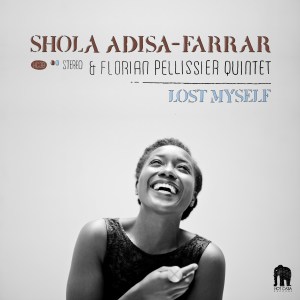
SHOLA: LOST MYSELF, A JAMERICAN, New Sound


LostMyselfCoverArtwork


OPA: Your first, awaited album, Lost Myself drops today. Congratulations.  How does it feel?

SAF: I am happy. I am proud. I am excited to know what people think, and to see where this project takes me

OPA: You wrote some of the songs on the album. Why did you go that route as oppose to just doing all jazz standards?

SAF: When Florian and I started working together we began by pure improvisation in his studio and exploring the sound we created together, ultimately leading us to produce original music. It is important for me to create something new, not just “redo or remix” something that has already been done. Also I wanted to mark this collaboration, capture this period in time with music that was personal us, music that came from us.

OPA: One of my favorite songs of yours, “Just You (Suspicious),” written for Trayvon Martin is not on the album.  Why was that song omitted?

SAF: This album is a collaboration between myself and Florian Pellissier Quintet, so all of the original songs were composed or co-composed by Florian. “Just You” however was created with another producer a few years back, so it didn’t fit into the concept of this album but I am still exploring ways to release that song and include it on other projects.

OPA: I happen to know that since your were about ten years old Josephine Baker was one of your heroines, and similar to her, you now seem to be living your dream of music in Paris.  Do you feel as if you are walking in her footsteps, that her spirit is guiding you?

SAF: I don’t necessarily feel as though I am walking in her footsteps as my career trajectory is different, but I do feel as though I’m benefiting from and walking proudly on the path that she and other singers, musicians and performers paved almost a century before my arrival to Paris. When I am in certain neighborhoods in Paris, I do feel the spirit of Jimmy (James Baldwin), Josephine (Baker) and Bricktop (Ida “Bricktop” Smith) and I imagine that some of the feelings and experiences they had once upon a time here, I feel at points too. It’s empowering to know that such incredible figures were able to find their wings in Paris. Being in Paris has definitely imbued me with newfound confidence and a sense of freedom.

OPA: Since World World II many African Americans have found haven in Paris as artists, in all genres. Would you say that Paris still offers that respite for African Americans to pursue and excel in the arts?

SAF: Yes, I believe it does, for a variety of reasons.

OPA.  Have you always wanted to sing, and what has prepared you for this moment, this album?

SAF: I’ve been singing since I was 8 years old, and though there have been many times when I was afraid to share my voice publicly and lacked the confidence to do so, singing is something that I have always loved. What has prepared me to enter this new chapter in my life is my perseverance to see this album through to fruition, my love of and respect for music and my passion to create. In addition I have studied others people’s careers development  and in some instances worked with emerging artists, so I feel as though I have a sense of what to expect, the unexpected.  I am a new artist, but I’m not new to the music industry.

OPA: You are a Ja-Merican. Although you were born and reared in Oakland, Ca, your maternal Jamaican heritage has been strong and lasting, and you spent a great deal of time in Jamaica when you were growing up. How has Jamaica impacted your development as an artist, and your sense of self?

SAF: It’s funny: my older cousins who recently came to visit me in Paris and who grew up in Jamaica, in Spanish Town, told me of one of their first memories of meeting me when I was a young girl in Jamaica. They said when I talked to them about what foods I liked to eat at the time, ackee n salt fish, stewed peas and rice and dumpling…they thought “ey ey aye ah who dis Yankee girl talkin bout stew peas n dumpling.” It was at this moment they realized that even though I was born in California that my Jamaica-ness was very much present and evident. This is obviously due to my mother who is a griot, really, and who makes it her business to collect our family history and to infuse her children with as much family culture and Jamaican traditions as she knows and practices. So this is a part of my identity that I like to celebrate and of course music is so important to Jamaica and Jamaicans that if I can use some of the Mento/ Reggae/ Soca / Dancehall elements in my music it’s a great pleasure for me to do so. In fact two of the songs on the album make references to my Jamaican background, “Blue Chords” and “What A Night.” The latter was inspired by a song taught to me as a child, “Linstead Market” and I decided to use the “what a night” lyric of this Jamaican folk song and flip the meaning on its head…

OPA: Does this album represent your voice, or are you still developing/finding your way to what might be considered your “true” voice?

SAF: Being that this album was created over a span of two years, my inspiration and my awareness of myself as an artist evolved. This album definitely does capture my voice, though during its teenage years, still trying to find and step fully into its identity, its true self and I am still working to further develop my authentic sound. Right now I can describe my music as a mix of jazz, Soul and reggae in order to create music that feels good, is poetic and is honest in describing aspects of human emotion and situations: conflict and struggle, joy and angst, curiosity and discovery.

OPA: Who are some of the artists who have influenced your development as a singer/artist?

SAF: Nina Simone and Ella Fitzgerald for sure. And of course many others…

OPA: So what’s next?  Are you ready to work on another album?

SAF: I am definitely ready to work on another album and I’ve been thinking of ideas for the next project: beginning collaborations with different artists and producers to continue developing my sound and creating new music. Simultaneously, I would love to tour within France and abroad to grow my fan base and connect with people through music.

OPA: When will you be touring the USA and the Caribbean?

SAF: Hopefully very soon.

SholaAdisaFarrar_0815_J.LEBRUN

Shola’s website is www.sholajoy.com
Like Shola’s Facebook page at: www.facebook.com/SholaAdisaFarrar

Here is a link to another interview with Shola:  http://www.southernworldartsnews.blogspot.fr/2016/04/singer-shola-adisa-farrar-drawing-on.html

The Shad Series: Jamaica’s Detective by Gillian Royes

Opal Palmer Adisa's avatarOpal Palmer Adisa

OPA:  The Rhythm of August Rain  is your 4th title in your detective series that is set in rural Jamaica. Are readers to believe that Shad, the bartender who plays an amateur detective, has real skills to seek out facts, or is he to be perceived as one who dabbles – this is just a hobby?

GR:Shad’s true vocation is being a detective. In another culture or time, he would have made it. However, due to his prison term and his lack of formal education, he is limited to working as a bartender and practicing his vocation on the side. He has few skills when the series starts out but tries to educate himself as it goes along. Above all, he is immensely curious.

OPA:  What distinguish this series as a detective genre?

GR: The series was created as a Caribbean parallel to Number One Ladies Detective Agency…

View original post 793 more words

The Shad Series: Jamaica’s Detective by Gillian Royes

OPA:  The Rhythm of August Rain  is your 4th title in your detective series that is set in rural Jamaica. Are readers to believe that Shad, the bartender who plays an amateur detective, has real skills to seek out facts, or is he to be perceived as one who dabbles – this is just a hobby?


GR:Shad’s true vocation is being a detective. In another culture or time, he would have made it. However, due to his prison term and his lack of formal education, he is limited to working as a bartender and practicing his vocation on the side. He has few skills when the series starts out but tries to educate himself as it goes along. Above all, he is immensely curious.


OPA:  What distinguish this series as a detective genre?


GR: The series was created as a Caribbean parallel to Number One Ladies Detective Agency. Both fall into the category of “cozy mystery,” not the typical blood and guts form of mystery. There is more character and plot development than mystery to this genre.

OPA: How did you arrive at the title, which has a very poetic ring?  How does the title connect to the central story of this novel?

GR: The title came to me one night in Ann Arbor in a dream. A woman in a bright blue dress said the words and told me it was the title. I got up and wrote it down.

OPA:  There are at least 3 competing stories, Shad and his impending marriage, his boss Eric and his relationship with Shannon, the mother of his daughter, and his daughter, and then the story of  Katlyn, the missing woman from Canada 30 years ago and her affair with a Rasta who is/was a member of one of the Rasta sects. Was it challenging during the writing process to juggle these three story lines and keep each going?

GR: No, I’m used to having one main plot and three subplots, part of the formula I use for the series. The subplots are ongoing, i.e., Shad’s relationship with Beth, Eric’s haphazard life, and the development of the hotel. The main plot differs with each novel. In this case, it’s the story of Katlyn and her entanglement with the Rasta community. By the way, I did know a Canadian woman who went into a Rasta community and came out dying.

OPA: What research did you do to writer about the Rastafarian community?

GR: I read several books written by Rastafari or about them. Barry Chevannes, Yasus Afari, Gerald Hausman, Leonard Barrett were some of the authors. I also discussed the philosophy and lifestyle with Yasus Afari.

OPA: What do you want readers to learn/take away about Rasta culture, it’s various sects?

GR: The point of including Rasta culture and history was to set the record straight, particularly for foreigners who don’t understand or appreciate the origins. I also wanted to show that prejudice has existed toward the group since its inception and, to a certain extent, continues today. Jamaicans are proud of the music, but many still would not want their daughter to marry a Rasta.

OPA:  Eric has not reached out to his daughter, Eve since she was born, and while you do reveal some initial tension between the two when they are reunited, she is a teenager, and Jamaica is very different from her Canadian environment, but it seems that all is forgiven rather easily.

GR: The relationship between parents and child is a complex one, in all cases. Eve is at an age where her emotions are heightened. She hates her absent father, but she’s curious about his world and wants his acceptance. She begins to see that he’s not a bad guy after all. I think a big part of her coming around is that she likes Jamaica and wants to return. Adolescents tend to be very egocentric.

OPA:   Classism and colorism are big social issues in Jamaica still, yet  it seems non-existent in the novel, in that Shad is accepted by Eric, even though American, his best friends are brownnose Jamaicans, who appear to be also accepting of Shad and his family? I don’t know if I have a questions so much as I would like to hear your opinion of these social constructs that impact relationships in Jamaica.

GR: In each novel, I have attempted to deal with a single social issue. I think it would make it too confusing if I’m following several plots and subplots and trying to introduce all the problems existent in the island. In my first novel, The Goat Woman of Largo Bay, the issue was political corruption. The second  — The Man who Turned Both Cheeks — discussed homosexuality and homophobia. The third was The Sea Grape Tree. I went into class and color prejudice in that book.

OPA:At the close of the novel, everything is resolved amicably, and all puzzles  are in place.  Given the context of Jamaica, would it be that easy to solve a 30 year mystery of a white woman in rural Jamaica who goes missing?  And given that tourism is such a big part of Jamaica’s economy, would the government have just brushed that case aside, like it apparently did?

GR: Fiction is not real life, just a reflection of it in the lens of a writer. I always leave things unresolved that are not going to leave the reader with an unfinished feeling. In August Rain, I tried to wrap most things up, in the event that I would end the series. Unfortunately, we never had a real resolution to the death of my friend Sharon.

www.gillianroyes.com