Opal Palmer Adisa is an exceptional writer/theatre director/photographer/gender advocate, nurtured on cane-sap and the oceanic breeze of Jamaica. Writer of poetry and professor, educator and cultural activist, Adisa has lectured and read her work throughout the United States, South Africa, Ghana, Nigeria, Germany, England and Prague, and has performed in Italy and Bosnia. An award-winning poet and prose writer Adisa has twenty four titles to her credit. Most recents are: Pretty Like Jamaica; The Storyteller's Return; Portia Dreams and 100 + Voices for Miss Lou. Other titles include the novel, It Begins With Tears (1997), which Rick Ayers proclaimed as one of the most motivational works for young adults. Love's Promise; 4-Headed Woman; Look a Moko Jumbie; Dance Quadrille and Play Quelbe; Painting Away Regrets; Until Judgement Comes;
Before you felt the life in your womb Before your child was born Did you think about what motherhood entailed? Did you understand that you would be a role model that unselfishness would be required of you? Did you truly understand what it would mean to care for another 24/7 and how you would have to adjust and adapt to your child’s needs?
Before you became a mother did you understand the sacrifices that you would need to make? Did you understand unconditional love was a requirement? Before you became a mother had you healed from your own woundedness so you would not pass on your hurts to your child? Before you became a mother did you love yourself? Had you forgiven your own mother for whatever indiscretions and failures she might have had? Before you became a mother were you able to hug and to forgive yourself? Did you know that your needs would often have to become secondary ? Before you became a mother had you fulfilled any of your dreams? Had you thought about what you wanted to gift your child what kind of a person you wanted to unleash upon the world?
Before you became a mother did you understand the astounding responsibility you would be taking up? Did you think about what stories and memories you wanted to implant in your child and how to teach your child to love and respect Humanity? Before you became a mother did you know motherhood was not a job nor occupation but rather a way of life? Did you fathom that motherhood is a gift to the world assuring our continuity? How lucky you are to have been chosen for such a responsibility… And how fortunate is the world when you honour your role and mother another to maturity.
Happy Mother’s Day to all mothers, regardless of gender.
Motherhood seduced me before I was a teenager. I knew I wanted to be a mother.
I practiced mothering on the other children in my community, dreamed of having children, and wanted to leave a stamp on the world. I did not know then nor did I understand all of the implications of motherhood, that my role was not to put a stamp on this human being I birthed, but rather to learn the lesson the child brings. Every child has an important lesson to teach that mother needs to learn and every mother has a lesson to teach her child: how the fragrance of compassion can restore the downtrodden, and how confidence can repair the sight of the blind.
Motherhood is not a mamby-pamby emotion. It is the mother of all poems; it is the bass in reggae, the survival instincts in dancehall, the emergence of land from volcano, and the assurance of a people who survived slavery.
Motherhood is getting your hands so dirty they can never be clean again; they will never be the same hands again and you will never be the same you again. Motherhood is the ingenuous taste of ackee and saltfish, the promise of bouganvilla, the glory of yellow yam, the dance of the hummingbird, the strength of lignum vitae, and the nutrients of banana.
Motherhood is not vain or pompous; it raises no flag to erect barriers; it is an open field, endless, expansive brave, daring, and celebratory.
Motherhood is rolling up your sleeves, bending your back and leaning into the hard work that must be done.
Motherhood tastes like guava jam in your mouth, smells like pork jerking, sounds like waves splashing rocks, feels like a hibiscus petal and intuits gratitude.
Motherhood assures us that there will be a tomorrow and Jamaica will continue to produce greatness.
Given the prominence of Jamaican women today, many might believe their stories have always been shared and heard, but this is certainly not the case. While there are certain categories of Jamaican women who have attained prominence, especially in middle management, this should not lead us to believe that we have achieved gender equality in Jamaica. In fact, despite significant progress, we are far from it and so it’s important that women’s stories get told. If equality is to be a reality for this nation of ours, then it’s important to tell the myriad stories of our unsung sisters so our little girls know the path that they’re walking on many before them cleared, often at great sacrifice. So while we know the male leaders of the Morant Bay Rebellion, how many of us know of Letitia Geoghegan, executed and Rosanna Finlayson, sentenced to 20 years penal servitude, two of the seven female leaders of that revolution who were tried for their defiance. Thanks to Clinton Hutton, Political Philosopher and former lecturer at the UWI , who in his book, Colour for Colour Skin for Skin: Marching with the Ancestral Spirits into War Oh at Morant Bay (date?), provides evidence of the active participation of women in that historical battle.
Trailblazing in Public Service (2)
All too often the history books – his story – forget women like Iris King, the lone woman who served on the Joint Independence Constitution Committee, and was the first elected female Mayor of Kingston in 1958. How many of our children know of her? Is there a monument in her honour? What treatment did she meet with from all those big-egoed men who felt they had the right to draft our constitution? How many nights did she toss restlessly in bed, charting a strategy to survive yet another day with men, some of whom made endless sexual innuendos, or outrightly spewed words to slash her and make her question her worth and ability. Iris King obviously paved the way for Portia Simpson who has been the first and only female Prime Minister to date, 60 years after independence. This indicates how far we women still have to go. Now, for the first time in our history, we have the largest number of women in parliament. I hope they are sufficiently woman conscious and will ensure that there is a gender budget and that those men who are associated with gender-based violence are not allowed to take up/hold political appointments, retain seats when wrongdoing is discovered, or represent our people in any position of power.
Essential Nurture Island-wide
But of equal importance are the women who provide us with food to put on our tables . I refer to these women in the Papine market and elsewhere, who are second generation market vendors, astute and shrewd. Women like Irene who gets up at a 3 am in the early morning to go and buy products and then sits in the market all day selling. Simultaneously, she raised and supported three children, and was able to build a house on her own. The informal banking system of “partner” that has allowed many working class women like Irene to start businesses, pay school feels and assist their elderly relatives with medical bills. Irene is another of our strong, determined woman who lives by the maxim, “One-one cocoa full basket.” Following in her mother’s footstep, who sometimes can still be seen sitting by her stall in the Papine Market, Irene and other vendors are our salvation, ensuring that we have quality produce and ground provision to nourish our bodies. Hard-working honest women who are the backbone of our society, who are often treated with disdain and little respect. Do you know the names of the women you buy from weekly in the market? Do you ever stop to ask how their children are, and what you could do to help them? To engage them is to be amazed at their resourcefulness throughout long days and small returns. Their propensity to provide for themselves to sustain their children despite meagre earnings is indomitable.
Intergenerational Legacies (4)
There are so many unsung heroines in Jamaica, including many modern-day formidable women among us such as Joan French, Judith Wedderburn, Joyce Hewitt, Lana Finikin, Shirley Pryce and countless others fighting the good fight for women’s equality and continuing to clear space for the women and girls who are emerging. Nor should we overlook it is likely that having the first Rear Admiral Antonette Wemyss Gorman to head the Jamaica Defence Force (JDF), is the reason why women soldiers felt comfortable to come forward with charges of sexual harassment that has resulted in resignation of senior male personnel. Women opening the door for other women to be safe and excel in what was considered male dominated spaces. In order for shy little girls to grow into confident, assertive women, they need to know the stories of the grandmothers and great-grandmothers on whose shoulders they stand.
Iconic Artistry Forever (5)
Almost all my adult life I have interviewed women, primarily, collecting and preserving their stories. I am awed at the array of phenomenal women who exist in Jamaica. I think of someone like Marjorie Wiley, the great cultural icon and percussionist who worked with the NDTC Dance company with Rex Nettleford, and with Miss Lou in the Pantomime and on Ring Ding. Whylie’s pioneering work as a drummer, in a field that was primarily, as she herself stated in an interview, dominated by men. What was it in her upbringing that allowed her to decide so young that she loved the drum and she was going to play the drums and other percussion instruments? Marjorie Whylie has taught many throughout Jamaica, and has done extensive research on our songs and other folk idioms, yet remains humble and gracious. She is certainly one of our national treasures who should be revered and her reservoir of knowledge plum and preserved.
Writing Women and Girls (6)
As a cultural and gender advocate and a creative writer I have consistently, throughout all of my work, documented and told the stories of a diverse range of Jamaican women, ensuring that their lives and deeds are not erased from the annals of history. Like many Caribbean writers, I occupy the role of scriber with reverence and believe it is my duty to reframe, reintroduce and reimagine our lives preceding our enslavement, and in particular since the epoch, by listening to the stuffed cries, seeing our unacknowledged? worth and beauty, the repeated trauma with no space for healing or reflection. Thus my very first short story collection, Bake-Face and Other Guava Stories, 1986, highlights rural woman in Jamaica, women who still don’t have a platform on which to share their stories. My most recent children’s picture book, Pretty like Jamaica gives nine year old Kathryn, whose mother has migrated to America from she was one year old. a place to tell her story, especially how she’s feeling about living in Jamaica and getting ready to migrate to join her mother and siblings in the USA and leave her grandmother behind.
From Herstory to Our Story (7)
I urge you to sit with your elderly female relatives and listen to their stories. At first, some might be reluctant to share with you, but sit quietly and gently prod them and their stories will unfold. In these stories are stored priceless treasures: wisdom, knowledge and experiences that can help us to navigate this 21st century…terrain more easily. Let us celebrate and honour our women and elevate understanding of their participation in building this nation, as equally as we regal the stories of our men. Let us draw solidarity from the peaceful men who, in spite of / irrespective of their own troubles/frustrations, do not resort to violence against women and children. Women are half of the nation, and their journey, struggles and triumphs must be sung and documented as loudly as their male counterparts for Jamaica to thrive. Big up our Women. Nuff Respect.
As we continue to celebrate International Women’s Day and Month with its theme: Digitall: Innovation and Technology for Gender Equality, I am forced to reflect on the applicability of this theme for Jamaican women. Many Jamaicans who are educated, live in urban areas, and can afford a helper, tend to forget that our reality is not that of the average Jamaican.
We need to be mindful of the fact that many people in this country who do not have the basics, such as electricity or running water, and that there are government-run schools in the inner-city and rural areas where children still use pit toilets. So vast is the disparity between those who have and those who have not. I endorse what Novelette Grant, Retired Deputy Commissioner of Police said is a starting point.
“Jamaican women need to support each other across generations, work, and think more intergenerational to pass on knowledge, wisdom, experiences, and life skills to help us chart these challenging times. If we don’t, then we are going to have an even more difficult struggle than we do now.”
I do not know who decides on international themes and their relevance to the world outside of Europe and North America. While I do believe it is essential that all Jamaicans are taught the effective use of technology, and provided with opportunities to be innovative, we must begin by understanding where the average Jamaican woman is and what her basic needs are in order to bridge the gap to innovation and technology. As a researcher, I believe we should start by asking women what their needs are. With this in mind, I reached out to several Jamaican.
Teresa, a single mother of four, with one son still in high school works full time in ground maintenance, said that “Women need more money in their workplace. Because a lot of them don’t have a father for the children; them is the mother and father; they have to buy food, clothes, they have bills, children have to go to school, lots of stuff.” Teresa touched on one of my core peeves and something Jamaica desperately needs –an end to single parenting. Every child comes into this world because of two human beings coming together, no matter the circumstance, and every child deserves not just a mother, but an active father.
Single parenting has been glorified and places an unfair burden on women who have been blamed for the plight of children, especially the deterioration of boys. Where are the fathers? The government must OUTLAW single-parenting which drains our society. Absentee fathers must be made to be accountable. Two things need to happen: Women need to starve these men who they know have children they are not supporting, and the fathers must be listed on birth certificates. Once paternity is determined, the father must be compelled to pay child support and actively engage in the child’s life. Until the culture of our society changes to prioritise family, the government must take stringent actions to bring wayward men in line for the effective development of our society. Jamaican women need to understand the power they have and ensure before having a child that the man they cohabit with, will shoulder his share of co-parenting responsibilities.
The need for work and economic opportunities was a need expressed by Nicole C., an Office Attendant who noted that when young women leave high school, despite having qualifications, they are not getting the job they desire. “Jamaica women need more opportunities to do certain things especially when it requires like ‘man work’; they feel like women cannot do man work.”
Women want more than non-traditional jobs, says gender advocate who goes by goes by the initials, RHDH. She adds, “they also need assistance to open or expand their businesses and access income-generating revenues and security; they need access to own land, build houses, have an accommodating workplace that takes into consideration a woman’s child and eldercare roles makes provisions to help them balance her work and home roles; laws and policies that understand and address the unique challenges women currently face – from GBV and gender bias.”
Another concern for women is safety, of which I am discretely aware as a single woman. There are many nights when I would love to just go for a walk, but I dare not, because I do not feel safe. I know if while walking at night something was to happen, many would point their fingers and ask why I was out at night. My freedom as a human in this society is restricted based on my gender. This issue of safety was shared by Margaret RH,, an administrative worker who believes women must have the freedom to walk on the roads and not be molested: “Even if you are walking naked.”
In order to achieve our 2030 goals, safety is a major concern as Nora-Gaye, a journalist added. “Jamaican women need a society they can feel safe in. Safety and security are constantly being eroded for Jamaican women who also need more safe spaces to escape from domestic abuse and other forms of gender-based violence.”
Creating a safer space for women will also result in creating a safer Jamaican for all its citizens and the government has to come up with a viable strategy to bring this about. So Narricka, a 20-year-old university student was on point when she declared, “Jamaican women need more representation in politics so that our voices and concerns can be heard and handled by people who not only understand but are willing to make a change.”
For the first time in our history, Jamaica has the largest representation of women in politics, and we wait with bated breath to see if these women will insist on a gender budget and push through policies that empower and protect women.
Finally, because women want intimacy and companionship, the women also discussed this area. “Women need a chance to be loved not used and abused because sometimes when women open up themselves emotionally, men take our vulnerability and use us physically and emotionally,” said Margaret, a point affirmed by RHRD.
“We need better men. Men who are kind, caring, nurturing, responsible and present.” I agree wholeheartedly as I know so many women who desire nothing more than to be loved and respected by some good, and available Jamaican men.
So, while Jamaican women must be a part of and strive to upgrade their digital and technological skills to be active in the global community, we must first focus on the basics of education, safety and health. Sidonie Morrison-Donald, Retired Nurse Administrator says it aptly, “Women need to be respected and be included at all levels in Plans, Programs and Decision Making process. As we celebrate Women’s Month throughout March, let us pause to ask women in Jamaica what they need and collaborate with them to ensure that these needs are met so they can continuously upgrade their skills. Women’s month is about all of us and how we move forward and develop this nation of ours.
We cannot move ahead if we see each other as enemy or we believe that we are in competition and fighting for limited resource for women and not for men. Often when I speak on gender-based violence immediately, many men stop me or counter that men are being killed too, of which I am acutely aware. However, men interjecting in this way says to me I am not interested in hearing about women being killed because men being killed is more important. Turning a deaf-ear to the plight of women, and not being open to engage this issue is to be complicit will not
As a feminist and gender advocate, I promote equality, equality for women and equality for men, equality for girls and equality for boys. I believe in the same way that women who are victims of gender-based violence should be offered protection so too should those men who are victims. Gender-based violence, regardless of the, sex, should receive compassion, support and guidance. This is not about competition or taking one side and ignoring the other. We have done that too much in the past and as we move forward we have to look at balancing the equation, but we also must be respectful and be willing to hear and attend to the pain and abuse of women.
Looking at gender based-violence, where 90% of the perpetrators are men killing women and men raping girls, does not mean that we are overlooking or ignoring the the alarming statistic of men killing each other. But GBV, and especially during IDEVA and the 16 days of activism which begins Nov 25 and which concludes on Dec 10, the International Human Rights Day, I am inviting my brothers and all Jamaicans to focus some attention to this very grave matter that not only impacts women and their ultimate emotional and physical welfare, but which has far-reaching impact on the entire family unit and wide-spread financial and social outlook of the entire society. The 16 days of activism is asking that we pay close attention to the victimization of women who ought to be allowed a safe space to be heard without the spotlight be turned on men.
“The direct costs of rape and domestic violence to the health system run in the millions of dollars, but the indirect costs in lost productivity, in the aftermath of a physical or sexual assault, are likely costing Jamaica billions” Moreno, L.G.(2015) Let us pause here and reflect on the financial impact on an already limited budget
Sexual violence against Jamaican girls is more than three times the global average (Al Jazeera, 2015; Lumsden, 2017).
In Jamaica, 40% of adolescent girls’ sexual initiation is forced and occurring while they were under the age of consent1 (Al Jezeera, 2015; Lumsden, 2017).
Over an eight-year period (2007–2014), 16,790 cases of child sexual abuse were reported, with two-thirds of victims between 13 and 17 years old; 21.1% between seven and 12 years old; and eight percent under seven years; 93% of all cases were girls (Jones, 2016).
COST OF RAPE/SV TO SOCIETY
Globally, sexual violence accounts for an estimated four percent of gross domestic product (GDP) due to lost productivity (World Bank, 2017).
– About half of teenage girls aged 15-17 in Jamaica experience sexual violence, Baumgartner et al,
(2009)
the WHO (2014), noted that if Jamaica reduced its violence rate by eight percent per 100,000 people, the country could increase its annual economic growth per capita by at least 5.4%.
Despite the postions that women hold in Jamaica, and how they are ranked world wide in terms of middle income jobs, we have to look at what consistently happens to women in our society because of our cultural norm and what both women and men have accepted as the way it is. a number of women who have said to me, yes and he beats because he loves me because they have accepted that distorted in the same way that I beat her because I love her but love is not love. I would like us to honor these 16 days active is am against violence against women because if we stopped and lessen the violence against women I am off to belief we will also lessen the violence against men because when men hurt women and children they are in fact acting out for place of her anger and fear and a feeling of disempowerment. We want to correct that we want to create a society where all people are safe, both women as well as men and children and boys; we want to change that aspect of our culture that has said because of survival because of enslavement that we’ve had to strike out. We have to move away from that and to now respond to what each other as brother or sister. I am not discounting your pain and your suffering but I need you to hear me and I need you to honor this. The 16 days off to end violence against women to speak to each other to speak to your brother’s to speak to your fathers and grandfathers to speak to those musicians who continue to glorify violence and homophobia in their songs how to say this is about all of us this is about our Salvation this is about our Coming to Terms this is about us send each other in a different way let us and these two statistics statistics let us end sphere that many people outside of Jamaica have that is impacting us we can make the 16 days to end violence against women an important turning point in Jamaica for all Jamaicans violence in the home impact not just the man and child with if their children it impacts them if there are other I don’t remember sitting tax them if their pets it impacts them not to mention the impact it has on the economy because when someone is hurt from gender-based violence it has tremendous domino effect throughout the entire Jamaican economy this is why we need to understand this is a serious matter that requires all of our support and help in it and in it the data gives us the base to let us know this volume of work that we need to do to be in alignment violence in the society is a clear indication that we are out of alignment with each other out of alignment with nature out of alignment with what it requires to build a society my fellow Jamaicans I appeal to you from a place of love and respect for every man woman girl and boy and I invite all of you to use the 16 days to heal to seek out counseling from a member of your church or the medical community someone who can help you to take that steps towards healing love is never ever about violence control and pain so let us move together as one people Anna these days and look at what is wrong and I was Society what is wrong in our culture that needs to be changed or eradicate the we can move forward that’s my invitation to all of us as Jamaicans.
Solutions:
Institute Conflict resolution skills training in all schools throughout Jamaica from grade 1 to form 6 to teach our children to learn to communicate in a calm reflective manner as many experience conflict daily in the home.
Establish and offer conflict resolution and effective communication skills throughout all parishes at community centers, and hold monthly town hall meetings on the impact of GBV and where to seek help before resorting to violence.
Jamaica currently spends four % of its GDP on violence overall (WHO, 2014). While that might not appear to be a lot, just image the fundamental and positive changes that would occur if even 3% were put into providing training skills and sustainable life-long good paying jobs for young women and men.
Engage and even commission our singers to write songs that reinforce effective communication and loving relationships.
We are an oral, storytelling people employ storytellers to share positive stories of cohesive family unit, intimate as well as platonic relationships
Erect billboards that show women and men arriving at non-violent resolution.
Create radio Ads and TV programmes that address the issue of violence and promote viable alternatives.
In order to correct this behaviour and damage to our society we have to tackle this from multi-pronged approaches and it has to be 24/7/365 days until we have transformed our ways to interacting with one another.
Give the grave and critical situation here in Jamaica we need more than 16 days, we need to attend to this issue year-round. Do join me in helping to restore peace and justice in Jamaica and make the home safe for women, girls, boys and men.
An abbreviated version of this article was published inThe Observer, on December 19, 2022
On the occasion of International Men’s Day which is being observed under the theme Caribbean a happy International Men’s Day. The theme of this year’s International Men’s Day: “Helping Men & Boys,” is rather general, but the Bureau of Gender Affairs’ theme: “Reigniting a Nation for Greatness: Man Deh Yah” more adequately addresses our need to know that men are here and present and reminds us to be mindful of the type of manhood that we showcase and how the men show up in this island space.
As a feminist and a mother of three adult children, I imbued my children with the same skills and values: respect for self, family, and everyone, confidence, and self-reliance. These core values have made all three independent, successful young adults who are making a place for themselves in the world. Sound parenting and positive role models are key to success, and I know our men and boys can lead meaningful lives with the right guidance.
It is important to celebrate a day such as this because celebration brings out the best in anyone. It is obvious that men and boys in our society are in crisis and we must pause and ask ourselves why. Who failed our boys and how? How do we help them now? If we don’t help, we all pay the price of living in a society plagued by crime, gender-based violence, and other negative social consequences.
Once what is meant to be a man was clear, but with development, some “manly” attributes have become outdated as everyone adjusts to changing roles. What this means for me, and hopefully for all self-respecting men is that they are present, willing to participate communicate and be accountable for their actions.
A smiling African American man stands in front of a blue wall wearing nice casual clothing. Positive lifestyle portrait. Shot in Portland, OR, USA.
Helping boys and men means we too have to treat them better, take their feelings into account, listen to them, affirm and guide them to discover their potential. We must strive to be as compassionate towards them as we are towards women and girls. Boys must understand that they need to be educated to contribute fully to society and understand that social and cultural equality benefits them as much as women.
portrait of a handsome bearded man with beard and mustache on a purple background
The message to boys and men this International Men’s Day is: we see you; we respect you; we honour you and we invite you to partner with us so that we can live in harmony and support each other to be our best selves. Walk good, my brothers.
Portrait of a senior man at home
Published in The Gleaner, editorial Page, Nov 17, 2022.
I can’t imagine why Jamaica would consider remaining with the Commonwealth. I truly do not understand why the Government is investing money in hosting the Duke and Duchess of Cambridge at this time when in Jamaica, every day, so many people go hungry, some literally starving as a result of COVID-19, when thousands of children have not gotten an education because they don’t have Internet access and now need remedial support, when so many roads are in need of repair, when violence, terror, and fear of illegally smuggled guns are rampant, when our beaches are eroding, and most citizens do not access to them anyway.
Why should Jamaicans be subjected to the rhetoric of the Duke and the Duchess about staying in the Commonwealth? What has the Commonwealth done for us except extracted our natural resources, brutalised us with colonial institutions, and exploited and overworked our African ancestors for more than 300 years?
Unless the Duke and Duchess are coming with an Official apology from Queen Elizabeth II and Britain, unless they are prepared to offer viable reparations in the form of at least four new state-of-the-art hospitals, providing every rural school with Internet and indoor sanitation, solar power, and a laptop for each child, repair all our roads, provide irrigation and machinery for all our farmers, provide mental health care for the many still dazed from the trauma of slavery, provide free tertiary education for every Jamaican child wanting to pursue such course of study, and other skills training for those who opt for other choices, building at least two museums and returning stolen artifacts, and augment the salaries of teachers, nurses and police , then I am afraid I can’t welcome them, nor sanction our government expending our money to host them.
But even with these overdue concessions, I am completely against staying with the Commonwealth. We were robbed of our African names, our religion, which was maligned, our language, and repeatedly lied to that we came from the ‘Dark Continent’, instead of being told of Africa’s vast natural wealth, gold, diamond, oil, natural gas, uranium, platinum, copper, cobalt, iron, bauxite and cocoa, that were and continue to be extracted to enrich Europe and the Americas. We were not told about Africa’s diverse civilizations, the Kingdom of Kush, Land of Punt, Carthage in Tunisia, Mali and Songhai Empires, the Great Zimbabwe so many others. We were deliberately miseducated and Christianity used to oppress us and deny us an education and destroying our family structure.
I hail Barbados Prime Minister Mia Mottley and I hope our own government and the rest of this region will take the brave step she did and stand up as a true independent nation, not simple changing the Union Jack for the Black, Green and Gold. It is time to right history and once and for all throw off the colonial legacy that has unchained and dragging us down. Why should much needed resources go to pay a Governor General who represents the Queen?
The Commonwealth was formally constituted by the London Declaration in 1949 to maintain its power and control over its former territories. When has the Queen really represented, cared for or protected us? What are the tangible and evident benefits of remaining under the Commonwealth? None!
Although many want to sweep slavery into the sea and say we must get over ourselves, we endured 179 years of severe brutality and terror, rape and mutilation, worked to death without pay, and at the end, our British oppressor were compensated handsomely for the loss of our labour and we were tossed aside with no land, no food, no home.
Jamaican scholar Orlando Patterson recently said that under British enslavement an estimated five million Jamaicans were lost to us. We have endured 400 years of colonialism and neo-colonialism that has made Britain one of the wealthiest countries in the world, and still to date we have not received an apology or any compensation. Shame, I say to the queen and Britain! Shame I say to the Duke and Duchess for coming here with such a bold-faced request! Shame I say to us for welcoming them and acting like beggars!
We must not allow our children or our people to stand in the sun and wave flags. We must be resolute and stand as a proud people in honour of Nanny, Tacky, Paul Bogle, and all the nameless heroes who risked their lives for us. If we are serious about development, liberation and the sovereignty of our people, if we understand what true Independence means, let us not dishonour ourselves, not subject our people to insult, not throw away needed money and resources on those who have continuously exploited and abused us.
Let Jamaica stand as a proud Independent nation. Let us get from under the Queen’s frock and the British Empire boots.
Louise Bennett’s contribution to Jamaican culture is undeniable and Miss Lou is already considered a National Hero amongst our people although the Jamaican government has not yet designated her as such. Miss Lou is the Queen Mother of culture because a queen mother according to the Ghanaian tradition, in which we have roots, is the one who selects the new king, and thereby determines the political and cultural course of the society. Miss Lou has directed many aspects of Jamaica’s culture, most fundamentally our language
Miss Lou advocated for throwing off the mantles of colonialism in Miss Lou’s Views, her radio monologues that ran from 1966 to 1982, and quiet clearly in her poetry, most often quoted in “Colonisation in Reverse,” but also evident in her pro-independence poems “Independance,” “Independence Dignity” and “Jamaica Elevate.” All were published in her Jamaica Labrish, first printed in 1966.
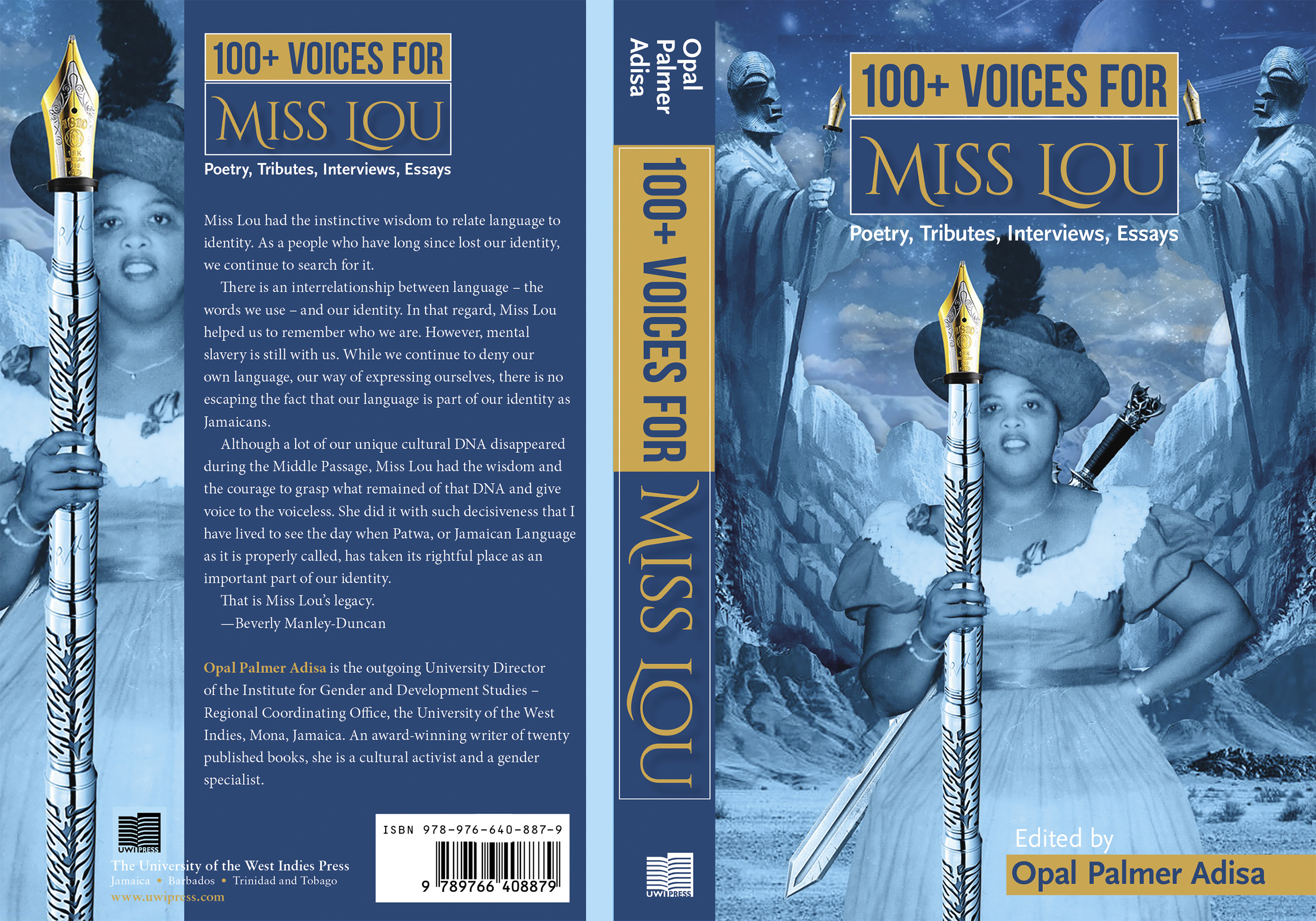
This Festival, like the anthology, 100 + Voices of Miss Lou that I edited, seeks to promote Louise Bennett and her work beyond the confines of the quintessential image of the bandana-clad folk figure.
Miss Lou was a multi-faceted, multi-talented woman who had to employ strategy to achieve the prominence that she did. Therefore, on the cover of the anthology, she is depicted as a warrior with her pen as her sword. Miss Lou as a warrior is not in conflict with Miss Lou the folk character because she was very aware of the times, prejudices, and stumbling blocks she had to navigate to make space for herself and the everyday Jamaican culture bearers. Tommy Ricketts, who designed the cover of the anthology, is also on a mission to represent Miss Lou through many diverse lenses.
In Anancy and Miss Lou, 1978, Bennett reveals another aspect of her repertoire, that of researcher who knows the history of this folk hero, and our African lineage. In the author’s note she states, “Anancy is an Ashanti Spider-god and has magical powers. He can change himself into whatever and whomever he wishes at certain times…” signalling to us that we too come from a place with a history and can be Anancy-like in achieving our autonomy and freedom, despite restrictions. The stories in this collection, though intended for children, offer so many moral lessons requiring the guidance of an adult.
What many might not be aware of is that Louise Bennett was not just curious and haphazardly collecting stories. She availed herself of training from as early as 1943 when she enrolled at Friends College in Highgate, St Mary to study Jamaican folklore. She then studied at London’s Royal Academy of Dramatic Art, the first black person to do so, on scholarship from the British Council.This is indicative of a person with goals who was charting a course. Upon her return, at the Jamaica Social Welfare Commission, where she began her career as an ethnographer in 1955, and worked until 1959, the cultural warrior got her hands dirty, so to speak, traveling across the island, collecting stories, songs, and proverbs, and training others such as Easton Lee to continue this work, at The University of the West Indies, Mona where she taught folklore and drama.
Louise Bennett was a master strategist, who was guided by her mother and maternal grandmother, to appreciate and understand the primacy of our folk culture and elevate these elements to another level, through the vehicles of poem and song and give it back to us to rejoice and add our communal voice, “Fi Me Love Ave Lion Heart”, “Dis Long Time Gal,” and “Under the Coconut Tree”, to name a few. Through her analysis, Louise Bennett showed and allowed the folk to tap into their resourcefulness and cunning borne of the need and exploitation, and most prominently, the big-heartedness of Jamaicans – our ability fi tek pain mek joke, to laugh at ourselves. Miss Lou achieved these things because she planned and was a master strategist. She executed her plans while helping others such as Harry Belafonte to achieve fame and notoriety. Belafonte, she coached so that he had the right rhythm and nuance that contributed to his 1956 hit Day O (The Banana Boat Song), a song that launched his career. Bennett also provided many invaluable inputs for Frederic G. Cassidy when he was researching and putting together Jamaica Talk: Three Hundred Years of the English Language in Jamaica.
As impressive as the works mentioned here demonstrate undisputable, Louise Bennett’s contribution and place in Jamaican culture, most ingenious is her creation of Aunty Roachy, a social commentator who spoke uncensored on every subject under the sun. We must begin by asking who is Aunty Roachy and from whom does she get her autonomy. This is where Bennett’s strategy is most masterfully exemplified.
Aunty Roachy, takes the focus from Bennett without displacing her, allowing Bennett to say what she wishes, free from attack, and consequently with more latitude to speak for the masses. Aunty Roachy is a post-Independent character, popularized between 1966 and 1982 via Miss Lou’s weekly radio show. Aunty Roach therefore can be read as representing the new nation, exploring its identity, and testing its ideas and opinions, all of which is framed around our folk proverbs, heavy with moral imperatives.
Finally, I want to situate Miss Lou’s Ring Ding, positing that Louise Bennett understood the need for a localized future, and that her show, the first of its kind, teaching and proclaiming the wisdom with a child’s audience was Bennett’s way of de-colonizing and detoxing the Jamaican child from the false traps of the Empire and giving her, her own myths and history so she could stand assuredly on firm legs, reinforced by the acknowledgment and praise, “Clap Yu Self.”
In this regard Ring Ding was futuristic, creating a platform for future Jamaicans to know and value their own culture, their cosmology and worth. And Bennett’s refrain and insistence, `clap yu self,’ was implanting as well signalling to our children the value of self-appreciation and self-acknowledgment. In order to create a future, we must be able to recognize, name and evaluate our actions, our worth, our essence, and this is what Miss Lou gave to numerous children on and through Ring Ding. How awesome and uplifting it is to clap ourselves.
Louise Bennett was a performer in the fullest and truest sense of the word, in that she orchestrated her own persona, and she lived ‘nuh ebry kin teet a laugh!’ Miss Lou, in fighting her way through the colonial values that dictated Jamaican society at the height of her career, values that were in complete and active opposition to the speech and traditions she performed, that she had to joke and smile to deflect and disarm her opponents. As the dub poet, Mutabaruka rightly pointed out, Miss Lou is the first dub poet, which is why he recorded her poem, “Dutty Tough,” which is as relevant and applicable as it was when she wrote it in the 1960s.
Thus, it would be legitimate to say that Louise Bennett is a visionary, and her work transcends the boundaries of time. As a performer par excellence, whether acting in Pantomimes or solo on stage as a singer or storyteller, Louise Bennett collapsed the space between self and self as other, executing liminal space – the person, the performer, the performance. This guise or disappearing while being present was part of Louise Bennett’s strategy and the reason, I would argue, she was able to endure throughout the decades with consistent vigour and charm, and become a staple, loved and adored, respected and admired, even grudgingly, allowed to execute her resolute goal, to celebrate and promote Jamaican culture.
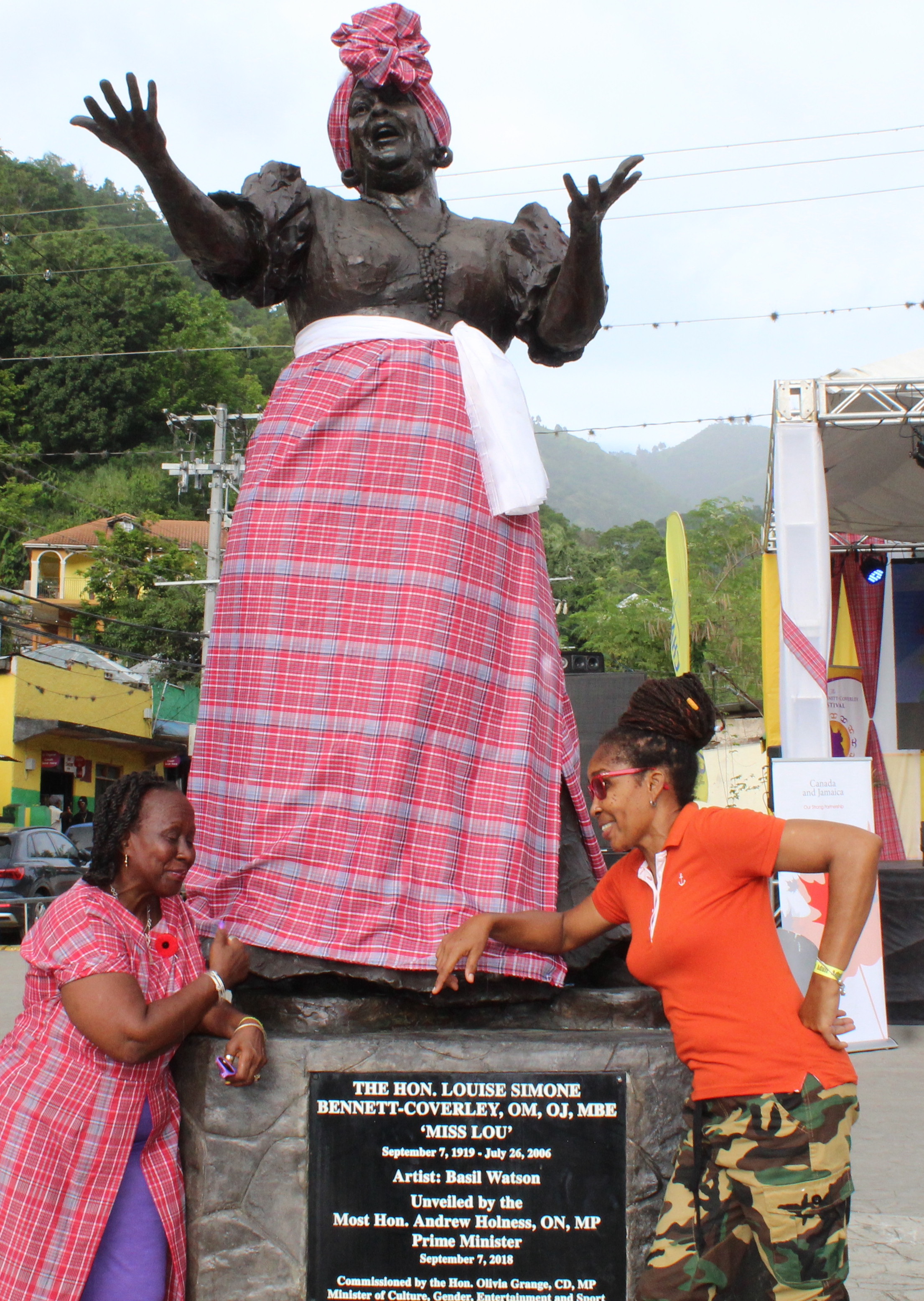
The inaugural Louise Bennett-Coverley Festival which took place on October 15, 2022 in Gordon Town celebrated Miss Lou’s milestones and the woman she was: one of Nanny’s staunch daughters who cleared many hurdles, circumvented roadblocks, and scraped her knees to bring us to this moment, 60 years old and proudly independent. Thank you, Miss Lou, for your vision and your tenacity. I salute you as an ancestor, change-marker, and keeper of our traditions. Asé to indomitable Louise Bennett-Coverley.
An edited version of the above was published In The Observer, November 27, 2022
The colonial education I received was primarily rote and students often got into trouble for raising questions that went against the grain of what we were taught. This goes against the very concept of an educated person as someone who can read, write, think critically, and is able to interrogate information, and seek answers.
As I review the content and context of my colonial education, I now know that it blatantly distorted history, outright lied about certain facts, and was designed to make me love, honour, and obey colonial edicts. As an educated woman in my sixties, who attended prep school then one of the leading high schools for girls in Jamaica, I wanted to glean if people from other decades were similarly subjected to a colonial education that distorted history.
I was educated to revere the Queen and Britain and there was never even a hint that the British kingdom plundered Africa and stole its natural wealth and resources, nor a mention that the British government kidnapped or trafficked more than 60 million Africans, and deposited them randomly; that they sold us, raped us, and sodomised us; that they worked us without pay, beat and brutalised us; that they fashioned over 100 different devices to restrict our bodies if we attempted to escape their barbarism, forbid us to speak our African languages, told us our Gods were demonic, told us we were inferior and that the meek would inherit the earth.
After all this, why wasn’t the horror and savagery of the African holocaust taught to us in schools? I sought to find out from Yvonne Sobers, now her 80s what she was taught.
“In school, I learned to pledge allegiance to the Queen and Britain,” said Sobers.
“Queen Victoria was presented as the saviour (and) the British were heroes along with Christopher Columbus. Every year we celebrated the Queen’s birthday and sang the British anthem and got little red flags of the Union Jack (British Flag) to wave while we sang. At high school, I got to carry the Union Jack as a leader, being a deputy Head girl,” reports Judith Wedderburn, now in her 70s.
Above, you have my point of view which represents those in their 60s and now we hear from RE, in his 50s, who declares “Up until third form I learned European history, then I moved to Jamaica College and I learned Caribbean history. The queen was always portrayed in a very positive light; her family’s connection to slavery was never mentioned. The British were portrayed as the ones who brought freedom through the actions of men like William Wilberforce and the local church.”
A similar sentiment was expressed by SAP, in her 40s, who said, “I was told at Prep School that even though Jamaica was granted independence in 1962, Queen Elizabeth is still considered the sovereign leader of Jamaica. It was not only the schools that valourised the Queen and the British Emprise, but the society, as well. One was measured by how British one spoke and act, and English standards were always the model.”
Representing the 30s age group Ruth Howard recalls “I was told that the queen is the head of state and our representative is the Governor General; this against the backdrop of the orphan island being discovered by Christopher Columbus and later adopted by the British Empire. Emphasis was never placed on the horrors of slavery.”
Oshane Grant, another person in his 30s has a very different view: “As a student of history I learned that Queen Elizabeth was a wicked lady and that her family hates black people and were primarily responsible for slavery.”
This would suggest that there have some changes in the education curriculum and the colonial propaganda. TC, who is in her 20s says she learned that we were colonized by the British…rooted in aspects of genocide and oppression.
“However, the British Empire embodied ideals that were to be lauded,” she said.
Current students appear to be given more information. “What we have learnt about the queen and the British Empire is their connection to the Caribbean or Jamaican History through colonialism, and they granted us Independence; we learned that this dominant Empire negatively affected the welfare of enslaved Africans and indigenous people.” Say Adiel a current 6th form student. OE, who has just entered 4th form says thus far she hasn’t learned anything about the queen or the British empire that she remembers, and this was seconded by MD, a 5th form male student.
Although this is only a selective sampling, through discussions I have had with teachers, there is evidence that now there is a more accurate portrayal of the British Empire. The question remains, however, is our children are being taught enough about their history to feel empowered, proud, and equipped to make decisions about their futures.
A revamping or realignment of the curriculum must be in alignment with our developmental goals that must be Jamaican-focused and advances our relationship to the global world.
Condolences to Queen Elizabeth’s family who has benefited luxuriously from the colonial exploitation of our ancestors. However, I hope that through education that teaches truth, and authentically explains our history, we can rise above this damaging legacy and be propelled to excellence and hopefully become a Republic so we can finally be truly independent.
The Harder They Come, the classic, cult movie turns 50 this year. Thus far no other movie about Jamaica has had such acclaim. The soundtrack put reggae on the international map. I was a teenager, and like all Jamaicans, were thrilled and proud of its debut. Many of us girls also developed crushes on Jimmy Cliff, and maybe even on Ivan, the character that he portrayed.
The Harder They Come resonated with me on so many levels, from the sighting of the country bus to Pedro at the beach with his sick son, to Elisa torn between her love for Ivan and her sympathy for the community. For the first time, I was seeing my home on the screen, whereas before all the images were foreign, and given to us, now we were giving ourselves to the world, to say to the world, look at me –I’m somebody too, worthy of attention – in short, my life and struggles matter. That was a pivotal identify shift moment for me and for many. Something happens to you, to how you see yourself, how you feel, when your life is now enlarged and being shown for all to see, to bear witness.
The character Ivan was living out and livng through the lives of the cowboy movies he watched, and now his fellow sufferers, fellow Jamaicans, were living their lives through him, seeing themselves objecting to and defying the system that has been crushing them. What a moment!What a revolution!What an awakening Perry Henzel and Trevor Rhone, co-writers, allowed for.
As I viewed the movie again I see that it is still relevant and applicable to today’s reality, and very little has changed for the masses in the inner-city and rural areas.
However, speaking with several musicians, they suggest that the industry has changed. There are more opportunities and less exploitation, although many local musicians who haven’t crossed over or had major success still feel there is still a lot of exploitation in the industry. But what is undisputable is that Reggae music is a global phenomenon.
So when Justin Henzel, Perry’s daughter asked me to write a poem for the 50th celebration, I was honored, and honored too to be included in the exhibition of poems and art, curated to commemorate the 50th anniversary. Below is the poem I wrote, focusing on Ivan’s portrayal, not as the hero as he was depicted, but as an anti-hero.




 Opal Palmer Adisa