
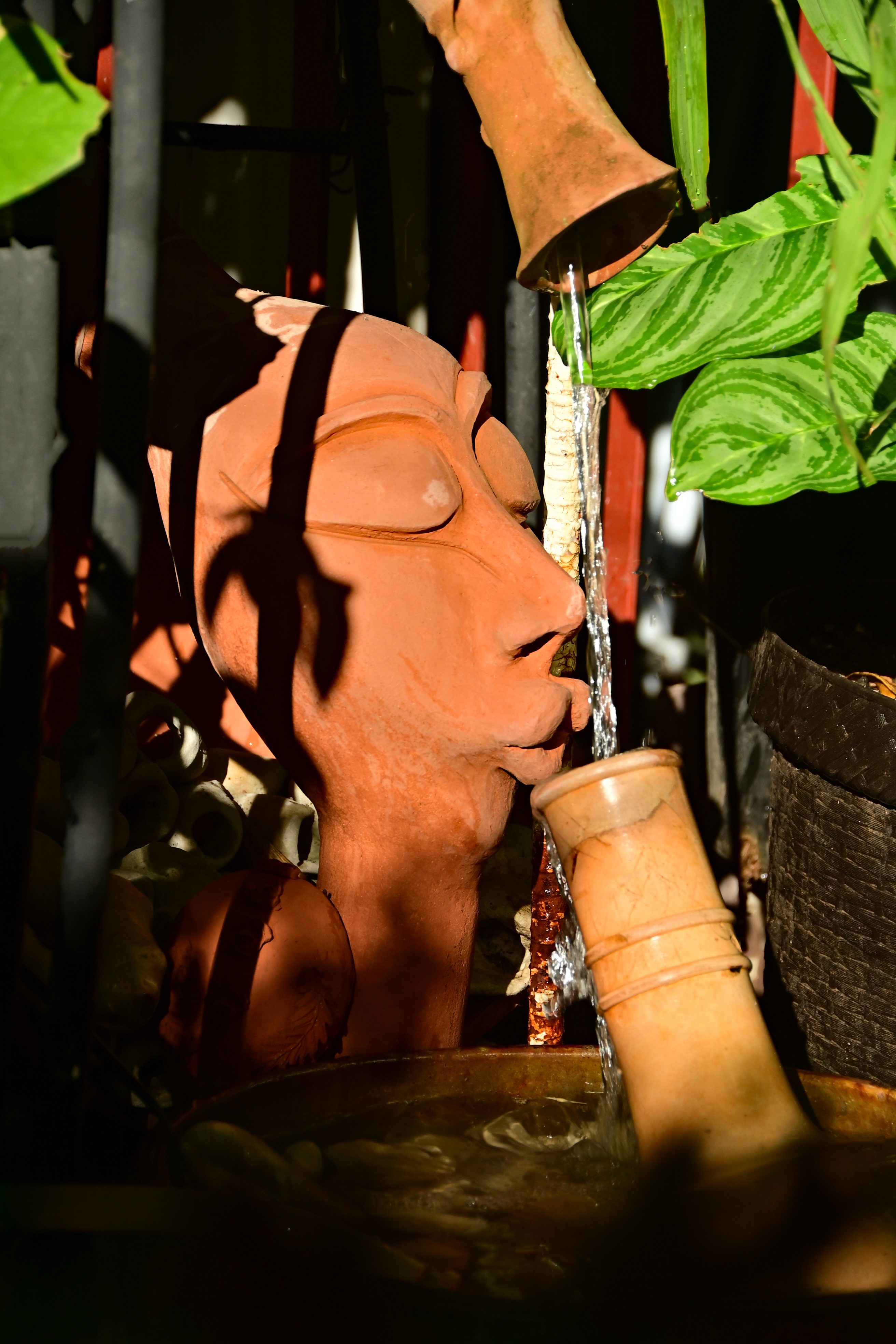
I had the pleasure of having breakfast with Donnette Zacca, one of Jamaica’s leading photographers. It was in her backyard, beneath the almond tree, light filtering through green like a whispered benediction, the sun warming my shoulders and the trickle of the water quieting my galloping thoughts. There was a fountain there and in the course of our conversation Zacca said, almost casually, that she had made it.
As a photographer (I too do photography) I know that light is everything. Light is revelation. Light is confession. Light is an open door, a path and a gift. Light is the difference between seeing and knowing.
At one point she moved my chair. Gently, deliberately.
“I want you to look at this,” she said.
It was the fountain. The woman who was the face of the fountain.
“Look at her. And tell me what she evokes.”
I have always believed that objects and things talk if you listen closely. This is not madness. Or perhaps it is the madness of the artist, that holy disturbance that insists the world is speaking. It was a profound experience and reminder for me.
As I watched the woman: stone, water, plants, silence, I heard her saying very clearly that she was beginning to see the light and that the greyness was lifting. I felt it almost physically, as if the greyness was rising from her chest up to her head, dissolving into the air. She was coming to recognize the light in herself and the light she brings.
And even though she had long worn a crown on her head, she had not recognized her queenliness.
Perhaps she was speaking.
Perhaps it was me speaking about myself.
Perhaps it was Donnette speaking through her into my head, forcing me to see, to really see.
Zacca spoke about how she loves the light from the sun under the almond tree in that amazing garden she has made; how she spends countless hours, days, weeks, maybe years taking images of the flowers in her yard from different angles, simply to see how the light plays with them. How the light tickles and arouses them. How the light transform them. Zacca is clear, ‘I witness the way light touches petal, leaf, stone, skin.”
It was a profound exercise in seeing and in giving voice to what you see. And I think how this guidance is so important to children, helping them to see, to open their eyes and their hearts. and see.
I think this is what artists do. They allow you, and sometimes they force you to see beyond what is visible. To hear what you are seeing. To understand that sight is not passive; it is participation. It is moving outside your head into your heart.
As an anarchist, as a writer, as a photographer, Zacca talks about the storytelling element in her photography. Anyone familiar with her work knows this. And certainly, as a writer of poetry and prose, I understand that impulse. My last adult collection, The Storyteller’s Return, is about seeing Jamaica after being away for a long time and asserting that storytellers are always present in our environment. The land remembers. The streets speak. The trees testify. The people expound and explode.
So when Donnette invited me to look at the light, to see how it reflected and played upon the statue she created, a statue she often uses as meditation, she was not simply offering another lens. She was offering an invitation, and gifting me another lens through which to see.
And I am sharing it because it is an invitation for all of us.
To see what is in front of us.
To hear what is in front of us.
To understand that the environment and the objects around us are witnesses.
Even though they are supposedly inanimate objects, they reflect, diffuse, and project their own stories onto us. They wait for our attention. They wait for our humility.
If we listen.
If we look keenly.
If we allow someone to move our chair.
So I want to Big Up Donnette Zacca, whose work I very much appreciate. Ithank her for reminding me what seeing is and how necessary it is, in this distracted world, to truly see what is already present in our environment.
Because sometimes the light is there all along.
And we are simply waiting for someone to say,
Look again.
 Opal Palmer Adisa