
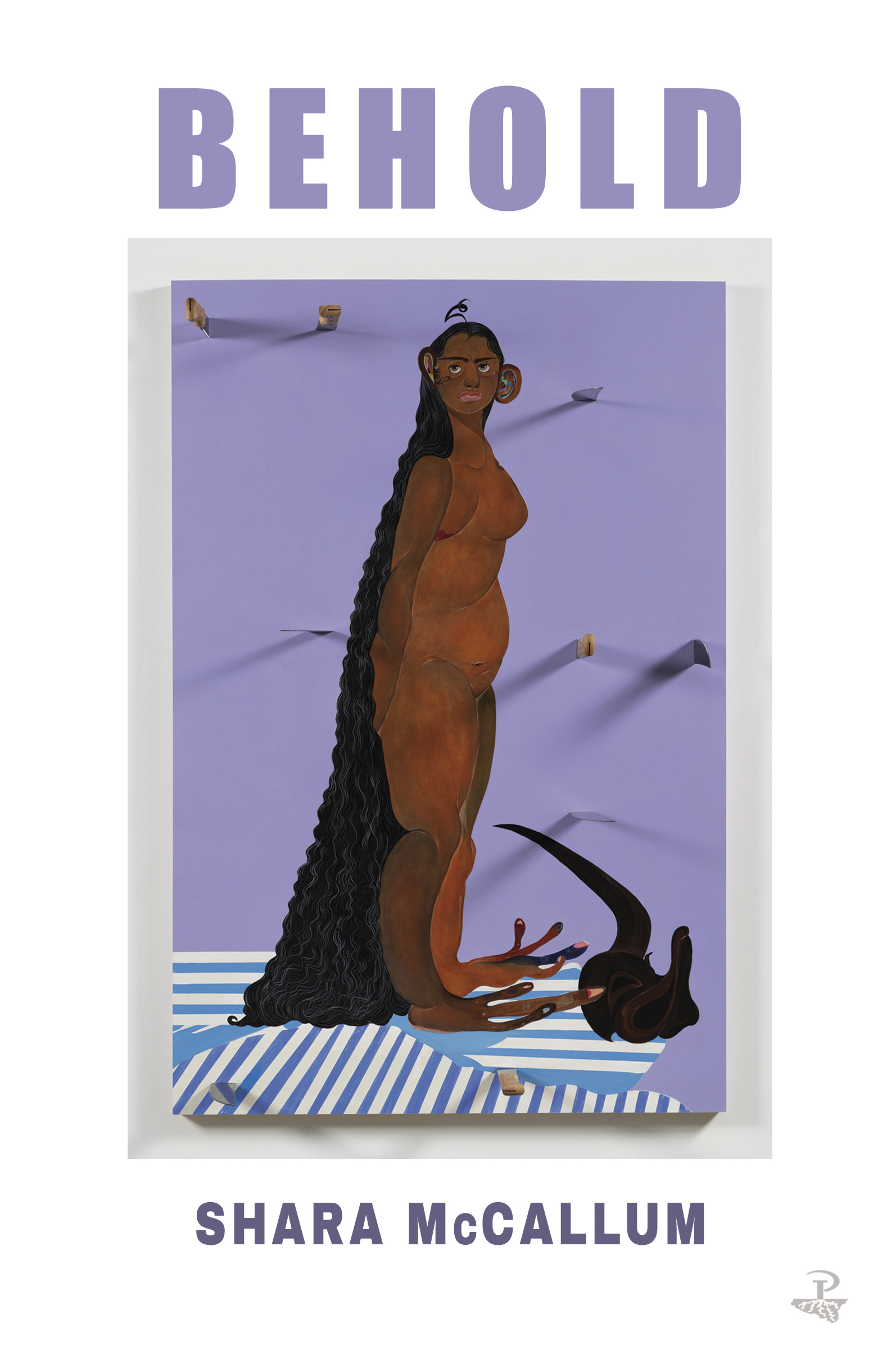
Shara has a new book that she is sharing below, but her aspiration remains :
“To keep writing and growing as a writer, in formal measures and emotional veracity.””
“Behold engages with questions of how we see and are seen. Its formal framework is ekphrastic and, as such, it includes poems in response to specific artworks as well as poems and brief autobiographical prose meditations that reflect on the history of visual art and my relationship to that history. The book also returns to themes that have followed me &/or I have followed over the past thirty years: memory, identity, myth, the self, migration, loss, the desire for & impossibility of return.
“Like many poets, I’ve written ekphrastic poems over the years. I began thinking about the form more intently and expansively around 2022. From July 2023-April 2025, I visited museums in the US, Jamaica, and the UK with the explicit purpose of putting myself in front of works of art created by Black, Caribbean, Latin American, and Women artists.
Regarding the title, Shara says: “I don’t honestly recall, but early on it felt like the right word to capture the collection’s interest in trying to see what is in front of us and, too, with matters of the spirit.”
And she rightly notes, “Books of poetry tend to appeal to other poets. Beyond that, I hope the book might speak to art critics & curators as well as anyone who loves to make and look at art, which I hope is many of us.:
One such poem from the collection invites us in:
How Often Do You Return
Whenever I eat porridge or drink tea.
Whenever the refrain poor me Israelites sounds
and somehow calls up castor oil, gentian violet,
iodine, mercurochrome—all the remedies for all
that could possibly ail you my mother knew.
Anytime I meet someone whose ha-low
are the two syllables it takes for me to suss out
they too are every day returning, who like me
says fi true and yeah man yet keeps marvelling—
Yu really from Kingston? Everywhere I go
where I see a mountain, even lickle hill rising,
am nearish a river or semblance of sea.
Predictable, kinda pathetic. I get it. But true.
Just as when night plays the fool
and a half-way-sorta-warmish breeze sends
late-summer’s flowers climbing ladders of air.
Is so my mind trellises. Is so
trickery abounds, when our one heart
is ragged, and the other runs roughshod over it.
“And whereas the poem might be referencing a specific piece of art, it also speaks to some of the movements of the time such as the recent Covid 19 and the Black Lives Matter movement.
“The moment I am living through in the US is both inside and outside the frame of the book but always present. As I say in one the end notes I provide on the artworks I reference in the book, I’m struck by how fortunate I was to be able to very easily see so many of the exhibits and art I saw in those two years of my travelling to museums while working toward Behold. In the time since Trump took office for a second term, countless art organisations have been defunded. Exhibits featuring artists like those I saw have come under incredible attack and many have been cancelled due to lost funding or curators fearful of retribution. Behold, in some ways, is a poetic gallery of what has been (temporarily, I trust) lost to our view.
Shara is well into her next project:
“I began an 18-month fellowship at the University of Leeds in late March and was in residence there for a month. I’ll return for a couple additional extended visits before the fellowship ends in August 2027. On my first visit, I spent time with the Peepal Tree Press Archives held at the University of Leeds’ Brotherton Library. I hope to write something—perhaps prose or a hybrid of poetry and prose—that comes out of my experience sitting with materials in those archives.
“I read far more than I write and often go months with just reading and taking notes, without the desire to finish a poem. I use a notebook still and write early drafts of poems by hand. After some time, I shape some of those drafts and other scribblings in my notebook into the poems I publish. The same process more or less holds for the essays I also write.
Central to who I am as a writer-person, SHARA MCCALLUM states, “I need no persuasion to sing and dance, my early forays into art as a practice and enduring loves.”
A History of Colour
American Lawn, Alex Callender
Once leeched from lapis lazuli, now
chemically-derived, named ultramarine
blue, the most beautiful colour
is the one that doesn’t exist. The painter’s
pigments, her selection of synthetic tints hint
at the roots of cobalt, cerulean, and azurite—
opulent, lushly expressed in larger-than-life
asters and big blue stem and marsh cord grasses
overgrowing the field filling-up this canvas.
Close-ups of purple-blue flowers showcase
their black centres, massing a galaxy of stars.
Here and there, cyan blossoms erupt
into flame. The sky above all this modifies,
darkening the palette while hueing it mauve,
with dash-like strokes that conjure a meteor
raining down. Everywhere, there are
intimations of danger and grandeur,
an abundance of nature that feels utterly
unnatural. On an indigo river running
through this lurid lawn, colonial relics bob:
pages torn from an 18th century book
of botanic drawings, chipped teacups,
a submerged, disembodied plaster head.
All are phantom presences, haunting
the surreal landscape of history’s graveyard.
 Opal Palmer Adisa