Tag Archives: poems

Kwame Dawes: “Turn to the alchemy of dub.”

Preamble:

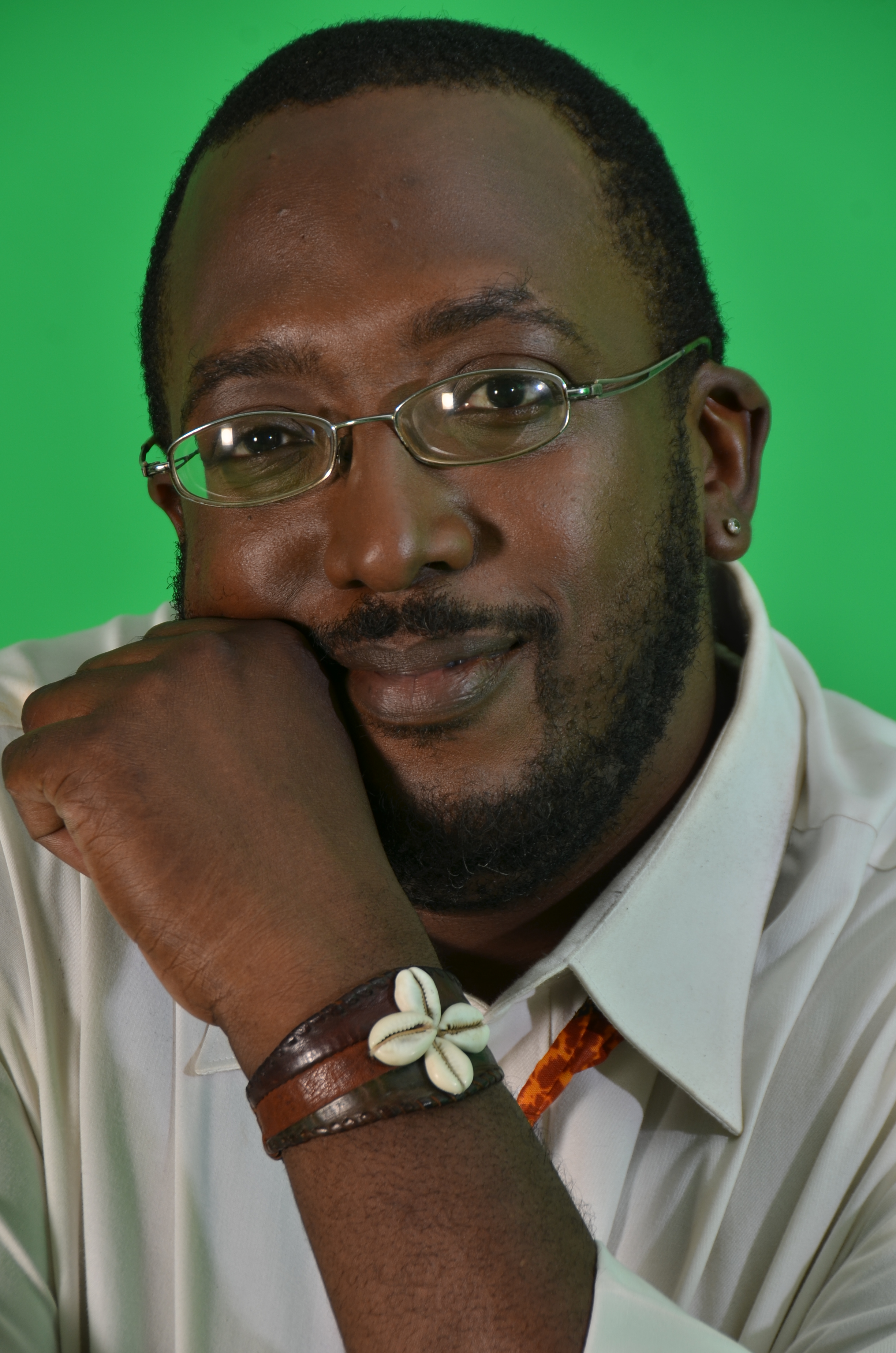
“Love Affair with literature,” is an annually event hosted by the department of literatures in English at The University of the West Indies, Mona campus. The department  invites a prominent writer to read works that speak to the topic, whichever way the writer interprets the theme. The invited writer this year was none other than Kwame Dawes, with laudable accolades, which anyone can get from  the internet. I was asked to introduce him, and therefore, thought it would be a disservice to just read his biography since anyone could.  Instead, I decided  to personalize the introduction as I have known Kwame for  over 20 years.  Although not close, we have been engaging each other  in one capacity or another. Also, I wanted to  use his poems/word to introduce him; so here is my introduction of Kwame Dawes

“Turn to the alchemy of dub,” is, for me, an unforgettable line from Kwame Dawes’ poem Faith. Just that phrase alone tells us something essential about the poet we welcometonight.

To speak of dub as alchemy is to understand something profound about this Caribbean region we call home, and specially Jamaica. Dub music, born out of rhythm and experimentation, is indeed a kind of alchemy as it takes fragments such as sound, memory, slices of history, bass, and voice and transforms them into something larger, more grounding than their parts and that sits in the base of your stomach, well at least mine.  Transformative.

When Dawes names dub alchemy, he shows us something about his own poetic imagination: a deep respect and understanding for Jamaican creativity, for Caribbean ingenuity, for what our people have made out of centuries of movement, struggle, invention, and survival.

The first time I met Kwame Dawes was when I was invited to Calabash International Literary Festival, after my collection Caribbean Passion, 2004 had been published by Peepal Tree Press. I remember a brief encounter  a moment before my reading. One of the poems in the collection, “Bumbu Clat,” is about the cloth women used  to use when they had their menses before pads.  The title of the poem is said to be the worse Jamaican bad word, and just a few week before my reading, an artist was arrested for shouting the word out on stage. (Absurd, but colonial ideology still rules and bumbu clat and other such words were still on the legal books, and punishable). Nonetheless I was determined to read the poem and I did. However, I remember asking Kwame just before I went on stage, if I could be arrested for reading the poem, hence cursing a Jamaican bad word at a public event. Needless to say I didn’t get arrested.

But that was not my first contact with Dawes, I remember getting an email from him, requesting an interview for his anthology Talk Yuh Talk: Interviews with Anglophone Caribbean Poets, which was published in 2000. I remember him calling me to make plans for the interview.

Since then, I have watched his career unfold; a career that stretches across continents and institutions, across poetry and teaching, across publishing and cultural leadership.

His tag line is “the busiest man in literature,” which makes him my twin in this regard as I regard myself as the busiest woman in literature. We are both hard workers.  Perhaps you don’t know that Kwame is the day name for a boy born on a Saturday in  Ghana where almost every child has a day name.  My day name is Ama. The nursery rhyme about children born on specific days says “ Saturday’s child works hard for his living, so Kwame’s success must be measured against his hard work.

But busyness alone does not define Kwame Dawes, who is a man with a clear mission to create space for others and to build platforms.

Dawes’s objective is  to ensure that poetry does not live quietly on a shelf but circulates through communities and across borders.

In another of his poems, Stray Paths, Dawes writes:

“This is the desire I carry
the moment of being announced
followed by the golden silence
of my presence.”

I believe that those lines aptly describe Kwame Dawes who is both public and private at the same time. A man whose work travels everywhere, whose presence is felt across the literary world and yet who carries within himself that quiet interior space where the poet lives.

The place where ideas are constantly turning and where imagination never rests.

If there is one thing you should know about Kwame Dawes, it is this: He is always thinking, always imagining the next possibility for poetry.

And through that restless imagination he has created something remarkable, and  has forged a path for himself and for others.

We see that mission in the co-founding of Calabash International Literary Festival, which has become one of the most important literary gatherings in the region.

We see it in the African Poetry Book Fund, which has opened doors for poets across Africa.

And we hope to see it continue to unfold through the Caribbean Poetry Book Series that bring Caribbean poetry more fully into the world’s literary conversation.

Because poetry, as Kwame understands it, must not only be written; it must be sustained, supported and given a platform to breathe.

Kwame Dawes shows us that poetry can be organized, nurtured, and even , dare I say it, monetized to build ecosystems where poetry can live and grow.

There is a stanza from Dawes’ poem, “Marked” that seems appropriate to conclude this introduction. Dawes says:

 “The poet must weep
when he returns, his linen
garments brown with the blood
of promise, his feet sticky
with the spilled blood of despair.
A soh it go.”

“The poet must weep when he returns.”

Perhaps that is where we recognize ourselves most deeply.

Because to be a poet in this time  and in this world is to carry both vision and grief.

As a poet, I weep every day for my island. I weep for my people. I weep for the world. I weep for a future where there will be less inequality, less gender-based violence, less child abuse.

But maybe, just maybe,  “a soh it go,” will be said not as a throw away but as an affirmation.

Because poetry reminds us that another way of imagining the world is always possible, including supporting our cousins and nearest neighbours, Cuba

And that is why the work of poets matters. That is why the work of Kwame Dawes matters.  He continues to turn again and again to the alchemy of dub, to the transformative power of language, rhythm, and imagination.

To launch his Poet laureateship this year he has continued and expanded the Edward Baugh Prize for adult writers from Portland, St. Thomas, Kingston and St Andrew; the Louise Bennett-Coverley Prize for adult writers from St. Catherine, Clarendon, Manchester, Trelawny, St. Ann and St. Mary; and the Michael Cooke Prize for adult writers from Hanover, St. James, Westmoreland and St. Elizabeth.

Kwame Dawes says, “For me as a poet and as the Poet Laureate, I see it as an opportunity to see what people are thinking, what they’re feeling, and how they’re writing those feelings. It is a way to promote part of our culture, the construction of a way of seeing the world through this creative mechanism.”

Brothers and Sisters, let’s welcome Kwame Dawes, Jamaica’s current Poet Laureate.

The Power of Nature: Judith Falloon-Reid

Filleting fish with 

a sharp machete, the master

bad as yaas! Fiyah! 

Poet, Filmmaker and Media Personality,  Falloon-Ried is also an adventurer, and is credited as the first Jamaican woman to visit Antarctica and has written, Antarctic Adventures with a Jamaican on Ice, 2020, that chronicles her trip. Here she talks about her new collection:

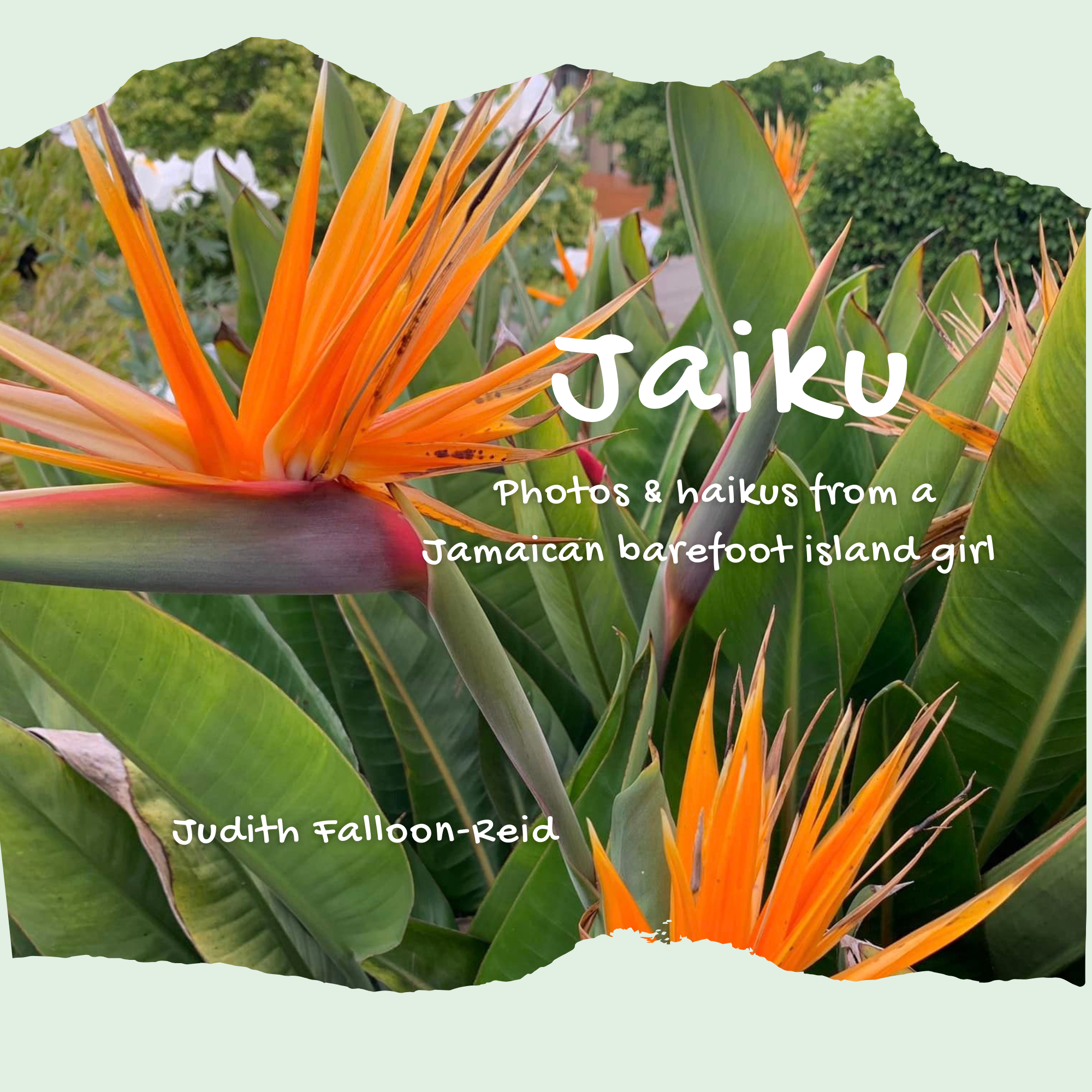
Jaiku, is a collection of Haikus and photos. In 2022, my husband and I moved to a small town called Puerto Armuelles on the Pacific Coast of Panama. The shift awakened my creativity in a new way. I had always been an amateur photographer and a nature lover, but living steps away from the untamed Pacific Ocean, having a yard filled with fresh fruits and flowers that grow and free from the stresses of America, I started writing haikus to accompany my photos and posting them on social media. The response was overwhelming. For me, this collection is a testament to the power of nature on our mental, spiritual, emotional and physical state.

Mango blooms in heat

A promise of things to come

Summer tun up high. 

While many authors sometimes find it challenging to come up with a title, Falloon-Reid’s focus was clear

Jaiku is a combination of Jamaican and haikus. I have used that hashtag for the past three years on social media to describe my combination of photos and haikus that often include Jamaican language.

It’s been three years in the making although, the idea of creating a book to house the photos and haikus didn’t materialize until early 2024 when friends and social media followers suggested that I create a book.

While the world cries blood

my garden blooms love and peace

man could learn something. 

Responding to the importance of this collection now, Falloon-Reid reflects on the technological impact:

In a world where AI seems to be taking over, it is important that live photography continues to have a space on bookshelves and in people’s consciousness. AI can never replace a photographer’s eye. AI has no emotion, empathy or ability to see beyond the natural. It simply mimics what already exists. I also live to inspire others to see their creative work, whatever it is, as valuable and I hope this collection will inspire photographers and writers to think outside the box.

A single red stone

defies the waves. I shall not

be moved. Be the stone.

While a writer’s process is often an indication of her productivity, Falloon-Reid keeps it simple but her ambitions are not:

I simply write as it comes. I know my main characters and storyline and how it begins then let it surprise me as it unfolds. I follow my characters as they tell me their story.

I aspire to be a famous author. I just want to write everything that is within me until my mind stops giving me words and my inkwell runs dry.

Writers, like the general public, are impacted by the social factors that arise. Here is what Falloon-Reid has to say about living under Covid 19, the Black Lives Matter movement, and the present US President:

I have always been considered a poet who speaks to issues of the day. I continue to write on the black experience, living in Amerikka and social justice in poetry. Jaiku is a little different. It has a mixture of observations, inspirations and social themes that accompany the photos and although most are haikus, there are a few poems as well. For example, the poem No Trees Aloud accompanies an image of machinery deforesting an area and speaks to the problems of gentrification and cutting down forests to build concrete jungles and the impact on nature. I also try to inspire hope in poems such as the one below that accompanies an image of a sprawling tee with massive roots.

With strong roots spreading

your leaves will shake, branches bend

but you will survive.

And like many writers who complete one project then go on to the next, Falloon-Reid might be doing some back-pedaling:

I am working on a relaunch of my novel The Silent Stones as well as filming season two of Mirrors in Paradise, a six-part series I wrote for PBC Jamaica, based on my book Are Mirrors Cleaner in Paradise?

The Silent Stones was first released 10 years ago but my mother passed away shortly after its release. I am updating it and doing a new cover before rereleasing it later this year.

Finally, the quirky thing about Falloon-Reid that you might not know is:

I don’t like structure, capital letters or punctuation. I use a lot of fragments. And, I like to start sentences with “with” and  “and”.

Website: jfalloon-Reid.com

YouTube: youtube.com/@Judithfalloonreid

Facebook: facebook.com/jfalloonreid

Instagram: instagram.com/barefootislandgirlja

fabian thomas: a 30+ year journey

JAMROCK

Wi laugh loud

go hard

dweet sweet

ramp rough

lick hot

dance wid screw face

a nation in trauma

acting as if there are

no problems.

fabian m thomas is a writer, poet, artistic director, spoken word performer, Performing Arts Specialist, and a Calabash Writers Workshop Fellow, and the above poem is from his new colletion , the solace of sound. Thomas says, “the title came from a section of words, which I consider the anchoring poem in the collection.”

Often the question is asked how does a poet put  a collection together, and this is thomas’ response to this  volume, which he describes as “A pot pourri, offering varying flavours for the palette of readers: sweet, tart, spicy, and even bitter, as I explore matters related to the heart, the head and the soul.”

Reading the poems in this collection, you will fully appreciate thomas’ poetry voyage, which he says “is the culmination of a 30+ year journey of writing, learning, dreaming, affirming, living, evolving and persevering.”

Fortunate to have had some seasoned mentors, Thomas credits  one such person, who also edited the collection. “It was my editor Prof Mervyn Morris, who suggested that I add spoken word to the description of the collection, because he said I “..write for the voice.” The audience I claim is those who love and are curious about the powerful allure of the spoken and written word.”

Responding to the impact on his writing and his life living under Covid 19, the Black Lives Matter movement, and the present US President,  these very different social realities, Thomas  offers: “I am present to the reality of people, forces and cabals that are determined to set us (black/people of colour) in particular, and the world in general, back, like resetting a clock to a time when we had no rights, value and free will. My response is “We will NOT go quietly into the night, disappear, shrink, but instead stand firm, take space, draw ranks, resist, rebel and overcome (again!). As in life, so in art, di livity muss ketch pon di page an di stage!”

His reponse  is in keeping with how he describes his writing process: “Live. Observe. Listen. Bear witness. Be witnessed. (Re)imagine. Ideate. Give form. Share (or not 😊).” Like many writers, thomas  aspires to “share my work as widely as possible…and meck money fram it too!!”

Active as a presenter, theatre consultant, Thomas  also makes time for his writing and has many plans:

“Having had the blessing of being published (by Independent Voyces Literary Works) I am now fully engaged in marketing and promoting the solace of sound, along with my previous works: Djembe (illustrated children’s book) and New Thought, New Words: a collection of affirmations, gratitude verses, spoken work and a bit of prose). I also plan to complete two books (a memoir and an exploration of my parents’ meeting and sojourn in the UK), and a collection of essays.”

We still are…

We were

kings & queens

before we were

enslaved

We

still are

In 2018, fabian m thomas self-published a collection of writings entitled New Thought, New Words. His first children’s book Djembe was released, February 2022 and Tribal Elements (A Tribe Ting, Volume 1), a chapbook of original writings by members of his performing arts collective Tribe Sankofa was launched in April 2022. He has two pieces in 100+ Voices for Miss Lou: Poetry, Tributes, Interviews, Essays (UWI Press, 2021).

Contact info:

i.am.fabianmthomas_writer_poet:  https://www.instagram.com/i.am.fabianmthomas_writer_poet?igsh=Z2NhOTZnbGV4a3Bt