Tag Archives: Literature

Kwame Dawes: “Turn to the alchemy of dub.”

Preamble:

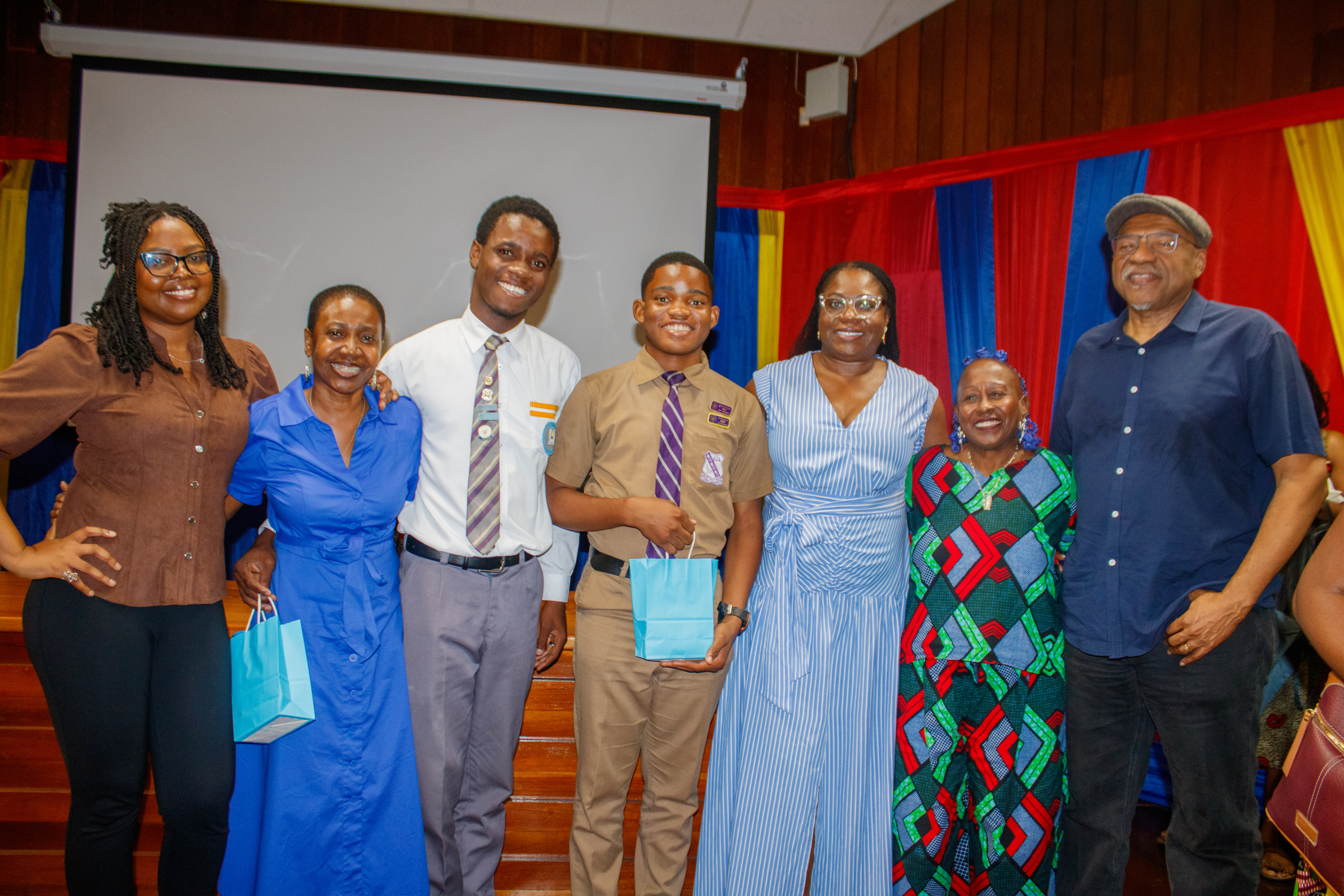
“Love Affair with literature,” is an annually event hosted by the department of literatures in English at The University of the West Indies, Mona campus. The department  invites a prominent writer to read works that speak to the topic, whichever way the writer interprets the theme. The invited writer this year was none other than Kwame Dawes, with laudable accolades, which anyone can get from  the internet. I was asked to introduce him, and therefore, thought it would be a disservice to just read his biography since anyone could.  Instead, I decided  to personalize the introduction as I have known Kwame for  over 20 years.  Although not close, we have been engaging each other  in one capacity or another. Also, I wanted to  use his poems/word to introduce him; so here is my introduction of Kwame Dawes

“Turn to the alchemy of dub,” is, for me, an unforgettable line from Kwame Dawes’ poem Faith. Just that phrase alone tells us something essential about the poet we welcometonight.

To speak of dub as alchemy is to understand something profound about this Caribbean region we call home, and specially Jamaica. Dub music, born out of rhythm and experimentation, is indeed a kind of alchemy as it takes fragments such as sound, memory, slices of history, bass, and voice and transforms them into something larger, more grounding than their parts and that sits in the base of your stomach, well at least mine.  Transformative.

When Dawes names dub alchemy, he shows us something about his own poetic imagination: a deep respect and understanding for Jamaican creativity, for Caribbean ingenuity, for what our people have made out of centuries of movement, struggle, invention, and survival.

The first time I met Kwame Dawes was when I was invited to Calabash International Literary Festival, after my collection Caribbean Passion, 2004 had been published by Peepal Tree Press. I remember a brief encounter  a moment before my reading. One of the poems in the collection, “Bumbu Clat,” is about the cloth women used  to use when they had their menses before pads.  The title of the poem is said to be the worse Jamaican bad word, and just a few week before my reading, an artist was arrested for shouting the word out on stage. (Absurd, but colonial ideology still rules and bumbu clat and other such words were still on the legal books, and punishable). Nonetheless I was determined to read the poem and I did. However, I remember asking Kwame just before I went on stage, if I could be arrested for reading the poem, hence cursing a Jamaican bad word at a public event. Needless to say I didn’t get arrested.

But that was not my first contact with Dawes, I remember getting an email from him, requesting an interview for his anthology Talk Yuh Talk: Interviews with Anglophone Caribbean Poets, which was published in 2000. I remember him calling me to make plans for the interview.

Since then, I have watched his career unfold; a career that stretches across continents and institutions, across poetry and teaching, across publishing and cultural leadership.

His tag line is “the busiest man in literature,” which makes him my twin in this regard as I regard myself as the busiest woman in literature. We are both hard workers.  Perhaps you don’t know that Kwame is the day name for a boy born on a Saturday in  Ghana where almost every child has a day name.  My day name is Ama. The nursery rhyme about children born on specific days says “ Saturday’s child works hard for his living, so Kwame’s success must be measured against his hard work.

But busyness alone does not define Kwame Dawes, who is a man with a clear mission to create space for others and to build platforms.

Dawes’s objective is  to ensure that poetry does not live quietly on a shelf but circulates through communities and across borders.

In another of his poems, Stray Paths, Dawes writes:

“This is the desire I carry
the moment of being announced
followed by the golden silence
of my presence.”

I believe that those lines aptly describe Kwame Dawes who is both public and private at the same time. A man whose work travels everywhere, whose presence is felt across the literary world and yet who carries within himself that quiet interior space where the poet lives.

The place where ideas are constantly turning and where imagination never rests.

If there is one thing you should know about Kwame Dawes, it is this: He is always thinking, always imagining the next possibility for poetry.

And through that restless imagination he has created something remarkable, and  has forged a path for himself and for others.

We see that mission in the co-founding of Calabash International Literary Festival, which has become one of the most important literary gatherings in the region.

We see it in the African Poetry Book Fund, which has opened doors for poets across Africa.

And we hope to see it continue to unfold through the Caribbean Poetry Book Series that bring Caribbean poetry more fully into the world’s literary conversation.

Because poetry, as Kwame understands it, must not only be written; it must be sustained, supported and given a platform to breathe.

Kwame Dawes shows us that poetry can be organized, nurtured, and even , dare I say it, monetized to build ecosystems where poetry can live and grow.

There is a stanza from Dawes’ poem, “Marked” that seems appropriate to conclude this introduction. Dawes says:

 “The poet must weep
when he returns, his linen
garments brown with the blood
of promise, his feet sticky
with the spilled blood of despair.
A soh it go.”

“The poet must weep when he returns.”

Perhaps that is where we recognize ourselves most deeply.

Because to be a poet in this time  and in this world is to carry both vision and grief.

As a poet, I weep every day for my island. I weep for my people. I weep for the world. I weep for a future where there will be less inequality, less gender-based violence, less child abuse.

But maybe, just maybe,  “a soh it go,” will be said not as a throw away but as an affirmation.

Because poetry reminds us that another way of imagining the world is always possible, including supporting our cousins and nearest neighbours, Cuba

And that is why the work of poets matters. That is why the work of Kwame Dawes matters.  He continues to turn again and again to the alchemy of dub, to the transformative power of language, rhythm, and imagination.

To launch his Poet laureateship this year he has continued and expanded the Edward Baugh Prize for adult writers from Portland, St. Thomas, Kingston and St Andrew; the Louise Bennett-Coverley Prize for adult writers from St. Catherine, Clarendon, Manchester, Trelawny, St. Ann and St. Mary; and the Michael Cooke Prize for adult writers from Hanover, St. James, Westmoreland and St. Elizabeth.
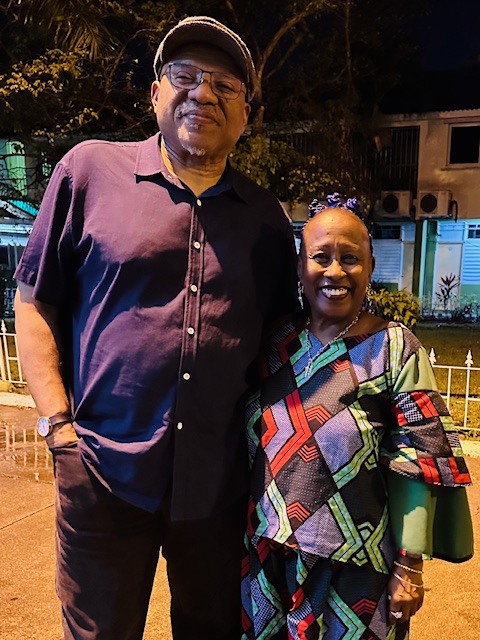
Kwame Dawes says, “For me as a poet and as the Poet Laureate, I see it as an opportunity to see what people are thinking, what they’re feeling, and how they’re writing those feelings. It is a way to promote part of our culture, the construction of a way of seeing the world through this creative mechanism.”

Brothers and Sisters, let’s welcome Kwame Dawes, Jamaica’s current Poet Laureate.
Nigeria’s Literary Star: Chimamanda Ngozi Adichie

When my book club selected Half of a Yellow Sun (2006), as our book of the month, that was my first introduction to Adichie. I had not read Purple Hibiscus (2003), but was impressed with her second novel, both the content (describes the Biafran struggle, 1967-1970, to establish an independent state in Nigeria and the awful Nigerian civil war that resulted in the lost and displacement of one million civilians) and the lyrical prose style that I decided to teach the book in my course on contemporary women writers the following year. Then when her collection, The Thing Around Your Neck (2009), was published, I read it right away and decided to teach it in my graduate seminar on short stories from the African Diaspora. The twelve stories that comprise the collection are fierce, penetrating and provide unique insight into the motives of humans living in Nigeria as well as the USA. A long-standing admirer of Chinua Achebe, whose books I devoured and also taught, and who was the first writer to open the doors to Nigeria and invite me to be witness, praise Chimamanda Adichie. “We do not usually associate wisdom with beginners, but here is a new writer endowed with the gift of ancient storytellers.” I certainly would not dispute the great Noble prize writer, and in fact concur that Adichie is an astute storyteller, whose works does not shy away from both political as well as social commentary, and as such she in keeping with the ideological perspective of many writers from Africa and the Caribbean who feel an obligation and responsibility to use their art as a vehicle to understand, and even heal the social milieu of their respective countries. So it was with this mind set that I bought tickets for my daughter, a good friend, and I, to go and hear Adichie at San Francisco City Arts & Lectures Series at Nourse Theater on Tuesday, October 1. Adichie was in dialogue with Dave Eggers, whom she claims as a friend at the beginning of the talk, related in great detail a story of Eggers’ visit to Nigeria, and him having to drive in Lagos, and avoiding bribing the police when they were routinely stopped. Chimamanda Adichie was very upbeat from the moment she entered the stage, fashionable and commanding, she directed the course of the conversation, throwing off Eggers prepared attempt to ask her specific questions about her book and her work. She talked at length about the writing summer workshop that she started in Lagos, and the number of talented writers that have benefited from that program. Also, she shared her path to being a writer, which forced her to veer from the medical career that was to have been her faith, instilled by her family. Raised very privileged, Adichie said she had a wonderful, almost idyllic childhood, and upon reflections now, wouldn’t change anything about her past. Nonetheless, or perhaps as a result of her comfortable life, she felt a deep sense of responsibility, to both country and family, when she wrote Half of a Yellow Sun. And in contrast, she emphasized, that her new novel, Americanah, 2013, that has garnered even more rave reviews than her previous works, was a departure from her other works and that she wrote it for herself, without any sense of obligation to anyone, and with a certain sense of freedom to both explore new terrain as well as experiment, and as a result, she didn’t think more than seven people would read it. I have not yet read Americanah, as my time has been absorbed reading and preparing for the graduate seminar I am teaching this semester on Haitian Literature, which includes several new texts to my repertoire. However the synopsis of this new novel indicates that it explores blackness in America through the eyes of its protagonist, Ifemelu, the young Nigerian who leaves a military ruled Nigeria for America. And although Adichie did not discuss about drawing from her own experiences attending university in the USA, she did say, with, it seems to me, still a tinge of indignation, her professor was surprised that she wrote the best essay in the class. She followed up this with by saying, and I paraphrase, I don’t know why he was surprised everyone knows that Nigerians are smart. In her world that was a given, just as blackness was a given, but the USA that she encountered that was not a given. In fact, the dominant discourse, which lumps all Blacks as the same, the converse is promoted as the truth. While Chimamanda Adichie did not elaborate in her talk about race, which does get boring for those of us whose experience of growing up in black countries, where everyone from the leader to the beggar is Black, we know the range and class difference that exist, and often find it tedious to continuously have to justify who we are to whose we deem ignorant or beneath us. After all, Es”kia Mphahlel, the great South African writer, hit the nail on the head, when speaking about African writers and their lack of need to name their blackness said, “A tiger does not have to declare its stripes.” It is self-evident. Without reading Americanah, I cannot say if Adichie arrives at the same conclusion, but I suspect that she might. More importantly, it is important for writers of African descent, for whom blackness is a given based on their experience of dominance and normative reality, tickle the ludicrousness and obsession of American racism that for too long has been a thorn thwarting the dreams and goals of selected members of its citizens. Adichie made is clear in her talk that she would not follow anyone’s agenda, and directed the course of the conversation. She did not need permission nor would she allow someone else to corral her. Yet, I must admit to being somewhat disappointed about the dialogue on two fronts. First, that Adichie did not read, even a short excerpt from the novel and second, given the plight of Nigerian girls and the political climate, that Adichie did not say anything on that subject. I suspect she had been asked about that issue ad nausea, but still, given her visibility, a concise statement would have suffice. During the Q & A, someone asked her about a feminist talk that she gave a while ago, and about how she felt that Beyonce used an excerpt of her talk in her song. Adichie deflected the question, but did say that among her nieces, to whom she had always appeared serious, being quoted by Beyonce scored her high, favorable points in their eyes. In all, the entire tone of the evening was lightly conversational and Chimamdana Adichie was gregarious and charming. Adichie’s Americanah is going to be made into a movie staring Lupita Nyong’o, who played Patsey in the movie, 12 Years a Slave. Already, the novel has won numerous awards including, 2013 National Book Critics Circle Award for Fiction, has been named One of The New York Times Ten Best Books of the Year
, and won The Chicago Tribune 2013 Heartland Prize for Fiction, etc, ect. When asked about her reservations about her book being made into a movie, Adichie was very clear that both forms are very different, and that she would not be involved in the movie in any way, and did not want to be, except to make sure that the actors’ accent was Nigerian and not the common, generic, erroneous portrayal of African speech. Seeing Chimamanda Adichie, the darling of the literary world, celebrating her Nigerian style, her poise and intellect in an easy engaging manner that makes it clear she knows who she is, and is unapologetic in her confident suave and candor, was a special treat. I look forward to reading Americanah novel, and perhaps adding it to my rooster of books I teach.