All posts by Opal Palmer Adisa

Opal Palmer Adisa is an exceptional writer/theatre director/photographer/gender advocate, nurtured on cane-sap and the oceanic breeze of Jamaica. Writer of poetry and professor, educator and cultural activist, Adisa has lectured and read her work throughout the United States, South Africa, Ghana, Nigeria, Germany, England and Prague, and has performed in Italy and Bosnia. An award-winning poet and prose writer Adisa has twenty four titles to her credit. Most recents are: Pretty Like Jamaica; The Storyteller's Return; Portia Dreams and 100 + Voices for Miss Lou. Other titles include the novel, It Begins With Tears (1997), which Rick Ayers proclaimed as one of the most motivational works for young adults. Love's Promise; 4-Headed Woman; Look a Moko Jumbie; Dance Quadrille and Play Quelbe; Painting Away Regrets; Until Judgement Comes;

From Choir Directing to Improv: Małgorzata Lipka

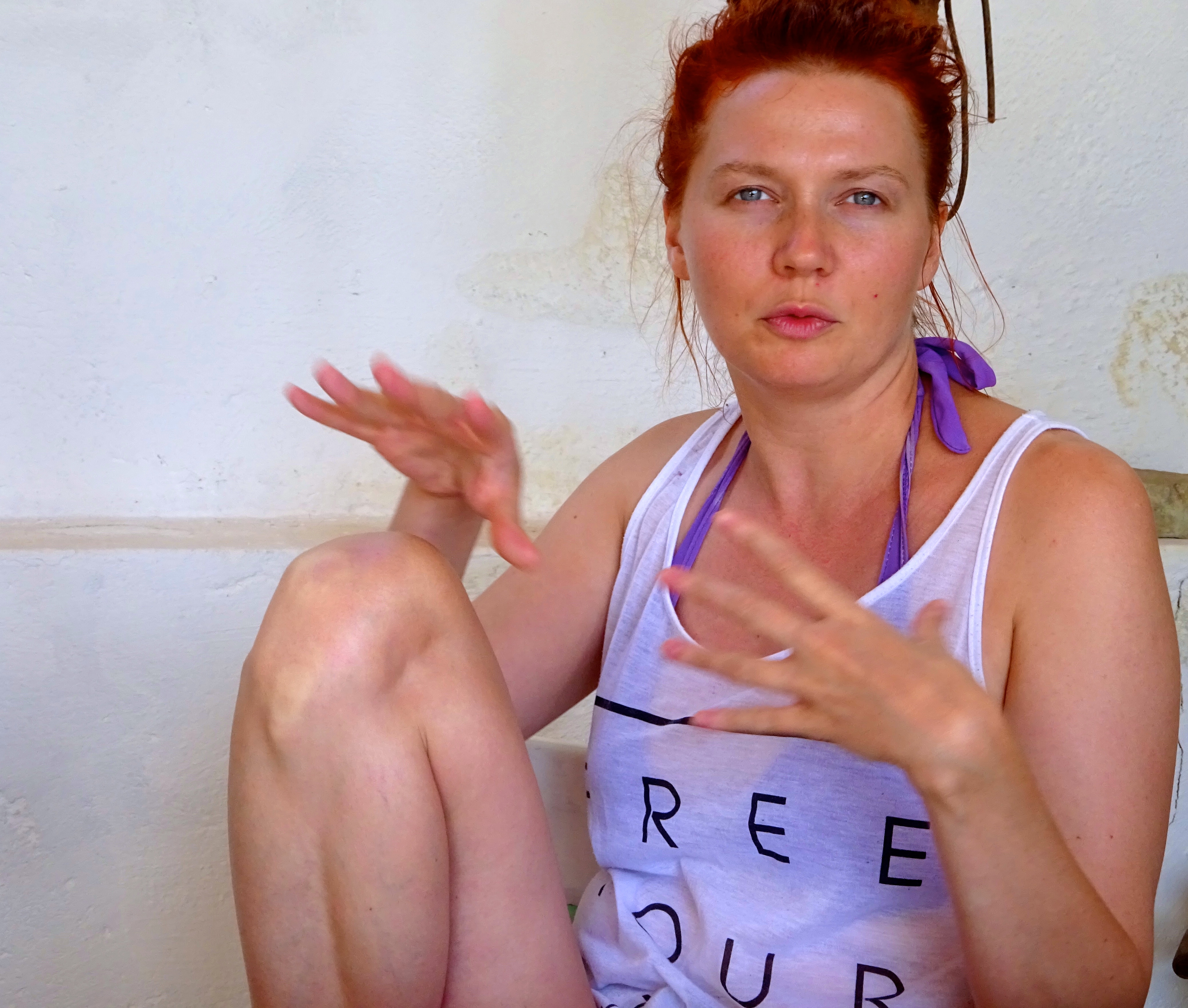
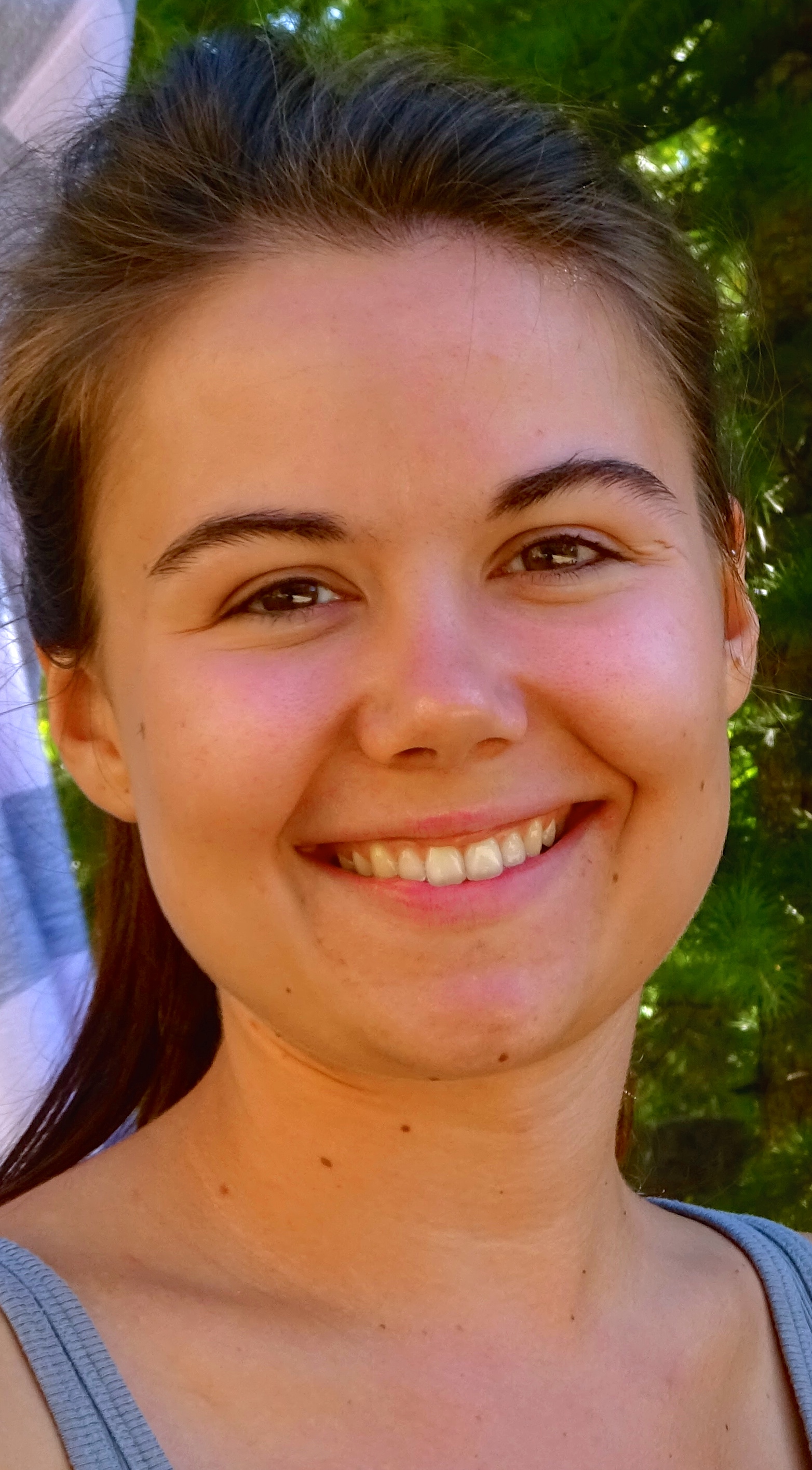
DSC02564Małgorzata Lipka, Polish, choir conductor, has a MA in choir conducting and music arts.  She was a violist for 12 years, and still plays, although now she refers to herself as, “a singer and a choir conductor, a teacher, and sometimes an actress. I also play violin, but I don’t do it in a classical way anymore. I am soprano, and find it easy to get high notes; the color of my voice is bright…” An indeed not only is Małgorzata’s voice bright, but she beams and has a vivacious personality.”

Having lived in Italy in the past, Małgorzata is inspired by its culture, DSC02556and this was her driving motivation to be in resident at Arte Studio Ginestrelle, to develop a project with friend, Aleksandra Markowska. They are working on a music and theatrical improvisation piece, in which they plan to incorporate some of the local music of Assisi. Also, Małgorzata adds, “Coming here, I’m hoping to meet international people from all over the world who can influence my work, in some way.” While there is no pressure to create new work or even develop a project, Małgorzata is motivated and wants to make sure “I spend my time in Italy in a productive and creative way.”

Seven years ago Małgorzata and Aleksandra met in Warsaw, where they live, while participating in a jest choir, and from there they quickly developed a friendship. They became roommates and began doing projects together, including forming a vocal quartet, which led to improvisation about destroying art. Thereafter they began a duet at the Night of Museums, where “we started exploring different sounds, and discovered we were having fun; we agreed that music is not just about notes and rules, but also about freedom.”

Małgorzata said she missed this freedom she discovered working with Aleksandra, and realized that that aspect was missing from “the things I was doing in Warsaw. With us, there are no rules.  We know each other so well, we feel the vibrations as a result of talking for hours.” Resulting from the above mentioned show, they performed at Comedy Club, which they realized was “an important place to improvise, and the public liked us.”  The rest, so to speak, is history. They were ready to forge ahead and hone their craft. It was Małgorzata’s idea to do the residency and she asked Aleksandra, who readily agreed to join her.

DSC02540 DSC02542

After listening to them practice most of the morning, being lulled and carried by their harmony, I joined them to learn about their project.  They were in the middle of practicing “The Flower Duel” by French composer Leo Delibes, but were getting ready to switched gears. In Assisi, they bought a score by an unknown Italian composer, based on old Italian music, as they wanted to sing something in Italian and something religious “because we were inspired by the religious atmosphere here.  We are also practicing modal church sounds –the voice we are using is more serious, like opera singing, but when we perform we use our more natural voice or pop.” Although their root is classic, they met doing pop. Malgorzata enjoys, “many different vocal techniques,” and plans to develop an improve repertoire with Aleksandra.

To learn more visit Małgorzata Lipka on Facebook

Exploring the Violin: Harriet Wheeler

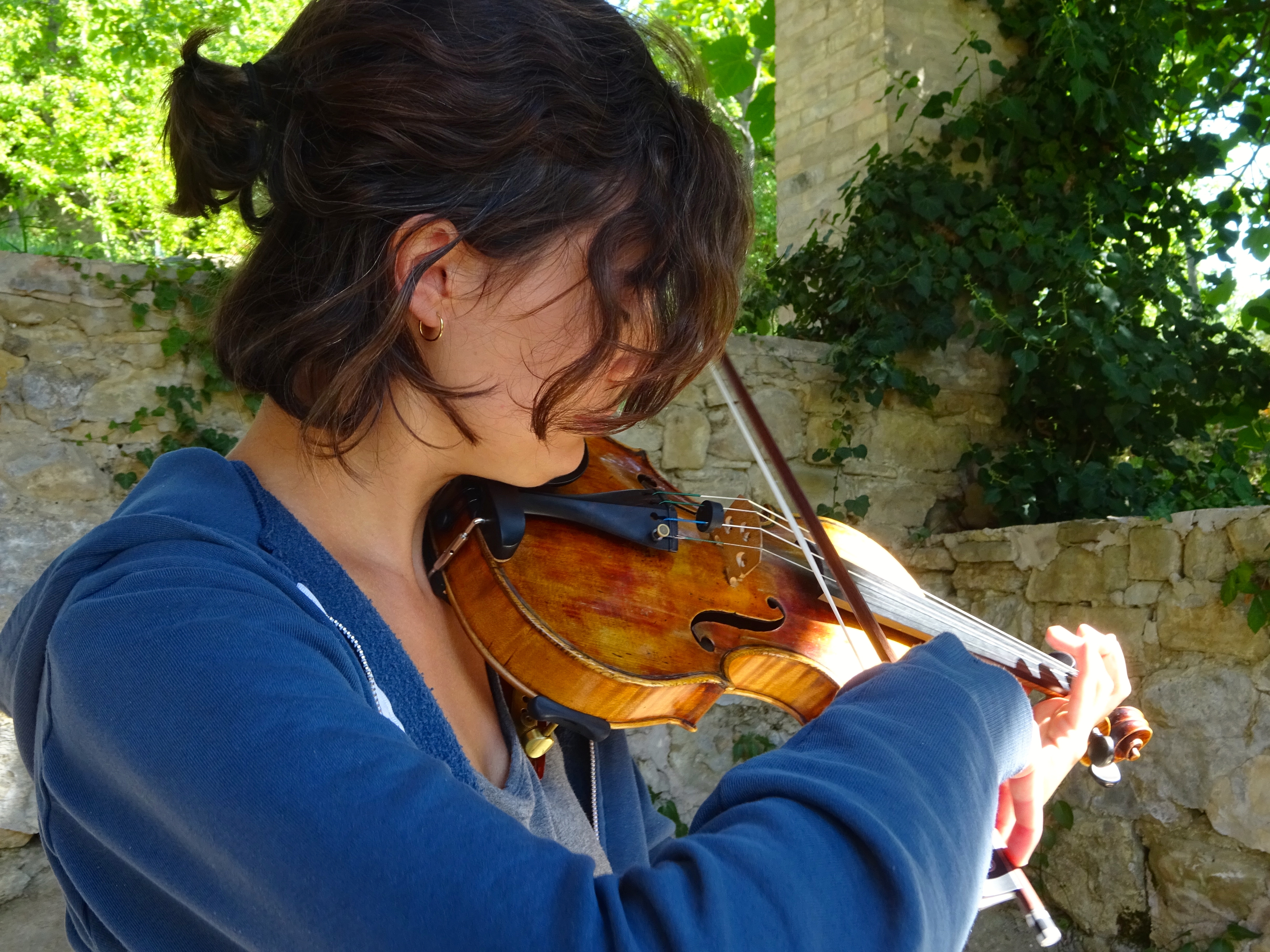
DSC02462Harriet Wheeler, British violinist, lives and works in Denmark, and was at Arte Studio Ginestrelle to work with Signe Lykke, Danish composer. Intense and committed to being a first class player, Harriet says, “I just aim to continue improving and evolving and bringing joy with the music I make.”

Harriet first became aware of Signe last year when she heard one of Signe’s compositions being played.  Although the piece was for the clarinet, she liked it so much, she contacted the composer, “and I asked her to write me a piece, and she did, “Blue Season,” which is a wonderful piece.” Harriet smiles at this memory, looking very much like a young Jacqueline Kennedy.DSC02552

As a result of listening to more of Signe’s compositions, and getting to know her personally, Harriet and Signe decided they wanted to collaborate, to explore how composer and musician can work together.  Once they arrived at this realization, they looked around for a space to begin this partnership, and learned about Arte Studio Ginestrelle, and were thrilled when they were accepted.

Practicing is fundamental to being a good violinist, and Harriet practices an average of 3-4 hours daily.  When practicing and playing, everything else ceases to exist, and she gets lost in a world of musical communications.  She is open and available to all.

“I don’t have a favorite composer; it changes too often and there are so many greats! I guess something about having a thirst for all styles of musical languages, especially classical?”

Although it is not usual for composers and musicians to work together on a piece, Harriet believes this should change.  Reflecting on an orchestra, Harriet says, “Contemporary music is created by composer, but Signe and I are combining the process, to explore what is possible with the violin, in a way that is natural for the violinist.”  Finding the possibilities and arriving at what is comfortable to violinists and other musicians is essential, Harriet states.  “It takes a lot of time, and we need freedom to experiment –try different sounds.  The process of us working on it together has been very rewarding. Signe would write something and give it to me, and she told me what she was thinking, and I was able to incorporate her ideas because she always asked me about things.”

Harriet and Signe will continue to work and develop this piece that will be performed -Spring 2016. “We will play with a young string ensemble in Denmark, work with young children to explore their instruments, and hopefully they will get more excited about playing.”

DSC02549 2

To learn more about Harriet Wheeler, visit her Facebook page.


My Poem, Madness Disguises Sanity

This is the link to the video:
We hope you enjoy the production, as we could not of created it without you. Also you may like to know that we all achieved the highest grade possible and we thank you very much. As this mean four of us have got into university and the other two are following drama carers through different paths.
See the production by High School students in England, who dramatized my poem, and interview…

Create in the MT. Subasio: Arte Studio Ginestrelle Artist Residency

DSC02276 Nestled in the lush, verdant mountains of Subasio, Assisi, Italy, Arte Studio Ginestrelle, artist residency was established in 2007 by Marina Merli, the soft-spoken, gracious, director.  Located in the Regional Park, the environment is tranquil and inviting, and ideal to start or complete any project. I certainly accomplished more in three weeks there than I did in the previous four months.

Marina Merli says, “The idea to develop an artist-in-residency program germinated after I finished my degree in Economics of Tourism and worked in the field of management. My desire grew to plan a cultural program at Subasio, the ‘sacred mountain’ of Assisi, to connect old traditions and history to contemporary minds worldwide. One of my aims was to offer opportunities for people interested in learning about the heritage of Umbria.” Known as the green heart of Italy —il cuore verde d’Italia— a phrase, lifted from Giosuè Carducci’s poem, Umbria is bordered by Tuscany to the west, Marche to the east and Lazio to the south.

DSC02577 DSC02570

I have been asked why do I need to go some place far to do my work, and the answer is simple. I go where what I do matters, and where I am given the time and am in a community that is likewise engaged. Another important aspect is the exchange that often occurs at great residencies. Marina concurs, “I think one of the main aspects in a residency program should be to create an International, cultural network for artists worldwide.” While I was there, artists from USA, Denmark and Russia were in attendance, painters, musicians and writers, creating a richly diverse setting.

Marina notes, “artists who apply to Ginestrelle are attracted by the natural landscape and are interested in finding a quiet place to focus on their projects, as well as the possibility to meet international artists.” Mount Subasio of Assisi is a journey into the past. “We can still breath the authentic style of life, sustainable and in harmony with nature. The ancient forest and sanctuaries (one of these is Madonna dei Tre Fossi from X century) represent the richness of this secret side of Assisi.” Marina continues. At Ginestrelle, where memories are preserved, you will connect to one of the cultural goals of the program.

In keeping with the personal and economic family values of Italians, Marina began this residency in collaboration with her parents who serve as board members of the Cultural Association Ginestrelle. Marina is grateful for their support and says, “They have always been involved in the projects.” And indeed they are, much to the delight of residents for the amazing breakfast that is prepared daily, mainly by Adria, Marina’s mother. But throughout the day, both parents are busy tending the grounds and attending to other things on and around the site. Mrs. Adria Eugeni serves as CEO Chief Executive Officer, and Mr. Enzo Merli, as Treasurer.

Yearly, Ginestrelle host an international art exhibition of projects developed by resident artists throughout the year, under the auspices of the cultural association of which Ginestrelle is a registered member of Assisi’s associations. The Assisi’s Council provides a prestigious art gallery space for the exhibition that will take place in November, 2015. For more information about this residency go to: http://artestudioginestrelle.wordpress.com/

Signe Lykke: Contemporary Composer Collaborates.


DSC02320Signe Lykke , Denmark composer
, credits her desire to collaborate from her non-classical, jazz background. However, she has a MA in classical composition, but believes that process is important, and that contemporary composers, such as herself, need to be familiar with the musicians who will be playing their music.  This is one of the reasons why Signe is at Arte Studio Ginestrelle, with Harriet Wheeler, violinist, to compose a piece, and learn more about the range of the violin, and what sounds are possible with other string instruments.

Passionate, and deeply committed to this process, Signe is quite fascinated and eager to work closely with classical musicians because, she says, “As a composer, you need your musicians to be engaged in your music and to understand the deeper meaning of the music. You don’t want robots playing all the correct pitches; they have to put their own feelings/soul into the music.”  Signe wants musicians to be able to identify with the intention behind the composition.  She stresses:  “When it’s new music, and you are the composer, you need to talk to the musicians, come up with a language you can both relate to and understand. “

As a composer, Signe is curious, and listens keenly to the various instruments, so that when composing, her compositions are stamped with her identity. We (she and Harriet) are doing a portfolio, examining different ways of exploring the violin.” She adds that what she is doing is not innovative, nor does she think it will amaze the world, but she beams, “The process is amazing!  We have come up with all these sounds; to us they are innovative, and they are personal –we have been playing around, improvising, having lots of fun.”  Signe believes playing around, discovering, is quite important, as well as necessary if a composer wants to collaborate and find new modes.  Although, a long, tiresome process, Signe says they are almost there, but the hard work still remains, that being, to figure out how “to put these extend techniques on paper, to write them down so musicians know how to play them.”

”When you do new music, when you hand your final piece to your player, it should be readable and as accessible as possible.  The musicians should be able to see the story, understand the feelings or whatever you, the composer, were thinking when creating the piece. I am quite excited.”

“I am about collaboration. I want to know what kind of musicians are playing my music. They all have unique sounds, but I have to get to know them as musicians, as artists, so that when I write a piece that is beautiful, they know where I’m coming from, and can put their soul into the piece.”

To learn more about Signe, visit her website: www.signe-lykke.com

Exploring Mother and Child: Jude Harzer

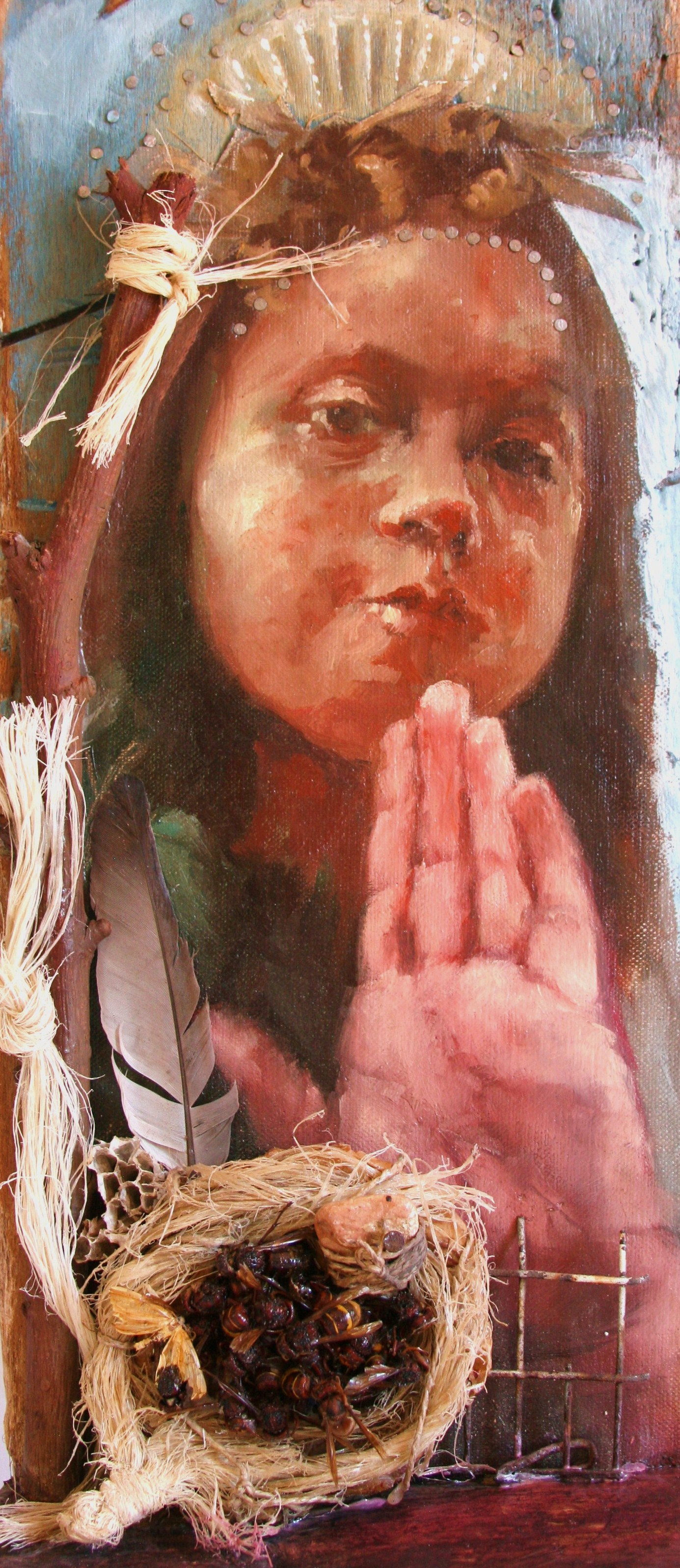
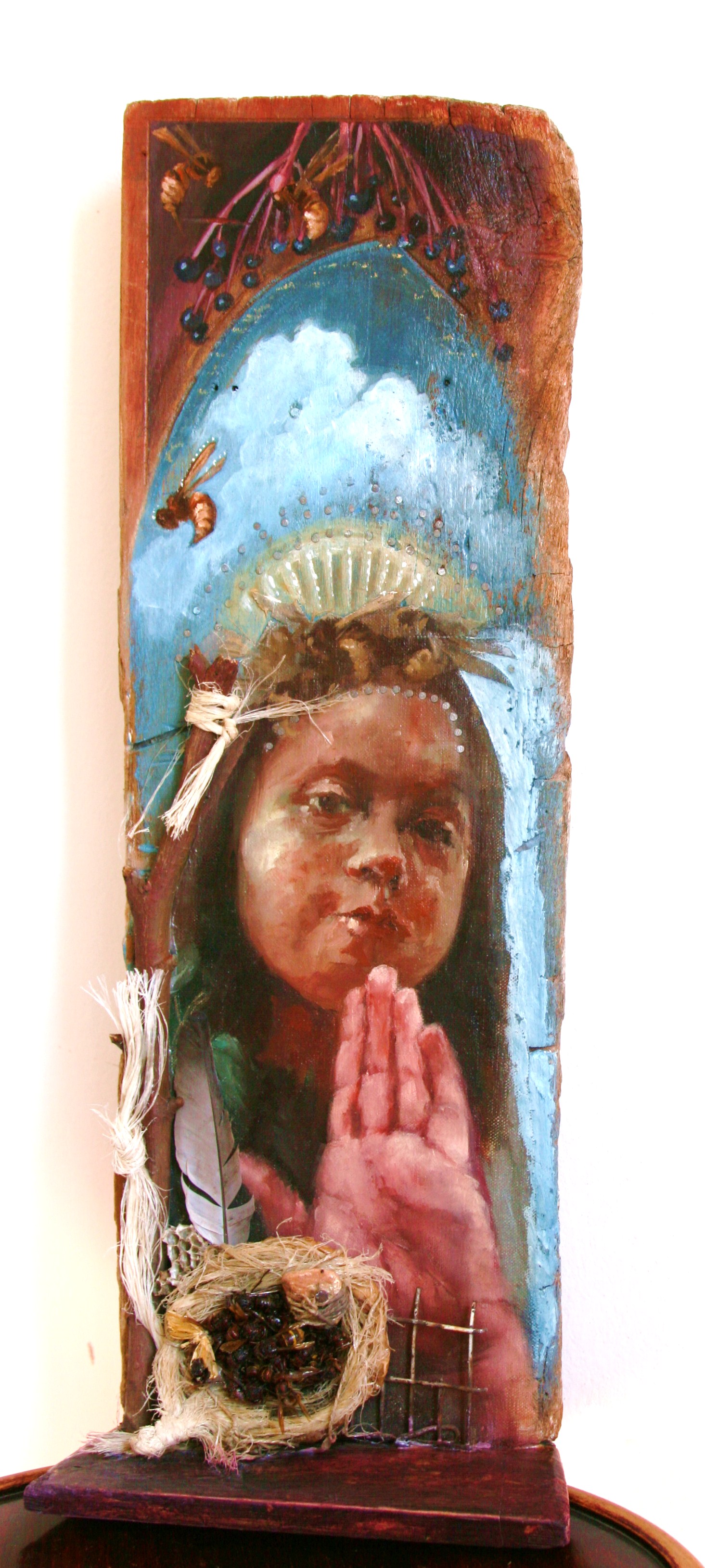
judeh.adisaJude Harzer, USA Painter, teaches high school visual arts and states that she came to her painting life rather late as she had abandoned this talent and desire for almost twenty years . Instead she married and raised children, thinking that she could not successfully balance family and career.

But now fully committed to painting, she is at Arte Studio Ginestrelle to dedicate full time to work.  She confides, “I’m in a state of personal transition regarding my marriage and creative pursuits. Also, my mother unexpectedly passed away about 18 months ago . This seemed like the perfect opportunity to attend this residency. The location near Assisi has personal significance as my mother shared a special affinity with St. Francis., the patron saint of Italy. Currently, in my work, I am investigating relationships between mother and child.”

Jude brought her mother’s ashes, which she scattered in Assisi. Her goal was to ‘create a found object altar piece that addressed familial relationships, celebration of women, legacy and how mothers, in particular, transfer their fears and beliefs to their children.” Jude believes that the intimacy of this relationship is the most powerful and profound.  Her residency is a personal as well as professional journey.

Reflecting on her process, Jude adds, “Even though you work in isolation, necessary for most artists, you’re also desperate for a like minded community. In a residency you are with a caliber of artists, from a variety of disciplines, that feeds your intellect and creativity.  This much needed inspiration rejuvenates an artist’s spirit.  Also, of course, I get to come to Italy, a country abundant in visual beauty and art.”

Jude accomplished more than she had planned, while also staying faithful to her objective.  Her work unexpectedly evolved , according to her, in response to the colors of the environment and the monastic quiet of the remote location. “The amber light of the atmosphere and the pink of the mountains , really impacted my work. I integrated the bees that came into my studio space as well and realized the relationship they held with the Madonna imagery that I was investigating. I was fascinated with the abundance of local shrines, placed at pedestrian and vehicle crossroads. I discovered that they are erected not only to celebrate the Madonna but also to ask her guidance when one is at the crossroads of life.”

Jude is at a good place in her life and looks forward to painting and exhibiting more.


To learn more about Jude Harzer, visit her website:http://www.judeharzer.com or like her artist’s page on Facebook:https://www.facebook.com/judeharzerart?pnref=lhc

L'Ape Regina detail L'Ape Regina

Artwork : L’Ape Regina: Protector of Soul and Spirit mixed media, 2015

The Music of Poetry: One Single Rose aka Rosemarie Wilson

IMG_0239Known to some as Rosemarie Wilson, but known to most in the poetry world as One Single Rose, Wilson has performed her self-esteem, motivational spoken-word poetry in thirteen states and four countries to date. She can be considered an ambassador of Detroit, her home-state, that she endorses and represents proudly.

Speaking about her development as a poet, One Single Rose says, “I’ve always had a love for words and books.  As a child, when my mom would take me shopping, instead of running towards toys I’d run to the bookshelves.  I’ve been writing poetry since the second grade when I won my very first poetry contest.  In adulthood, I picked up my pen once again writing songs, but the journey poetry is paving for my life is continually amazing.”

And amazing indeed, as this past August, One Single Rose attending the Kistrech Poetry festival, her first trip to Africa, the motherland, “but not my last,” she beams, adding, “I am forever grateful to the Kistrech Poetry Festival for selecting me as a spoken word performer in the 2015 festival.”

An incredible singer and performer, combing music and words, One Single Rose was a hit with students.

As a child, One Single Rose’s was taught “if you don’t have anything nice to say, don’t say anything at all,” and this is reflected in her overall attitude, and defines the content of her poetry.   Asked, what she took away from the festival, and Kenya in general, One Single Rose, offered some insightful observations.

“Sometimes we tend to fear what we don’t understand.  Prior to traveling to Kenya, I was warned about not doing this or that, not to go here or there by people who had never traveled to that part of the world.  Kenya is a beautiful country with beautiful people and a rich history.  Some areas in Kenya don’t have all of the bells and whistles that we have in the United States, but the people are happy.  Children don’t have school books, running water, flushing toilets or electricity, but they’re bilingual and are very well educated.  Some things we take for granted would be luxuries in Kenya.

“I have learned not to judge books by their covers without first reading a few pages.  Poets and writers share a common bond—love for the word.  I learned a lot from the poets who participated in the Kistrech Poetry Festival from different parts of the world about their cultures and their performance styles which were in some ways the same as how we perform in the United States.   Watching and learning from the poets who mentored during the festival made me even more aware of this fact –we are similar and connected.”

Her poem below is an example of her message, but you have to see One Single Rose in performance to truly experience her poetry.

As One

At first sight, we knew we’d come together as one.

Slowly becoming acquainted until comfort set in,

Appreciative of time taken to learn one another.

Everything gazed upon is loved from head to toe:

Smiles that make the spine chill as the interior froths;

Mental challenges forcing contemplation;

Ears that hear speech emitted by motion . . .

Every second is precious—never taken for granted.

Our dreams become reality.

Met at the right place and time when loving is easy,

Making persistent strides to continue as one.

Together composing romantic volumes of non-fiction,

Deleting final chapters.

There’s no end in sight.

©2009- All Rights Reserved

Rosemarie Wilson aka One Single Rose

IMG_0236

For more information on One Single Rose visit her websites:

www.onesinglerose.com ; One Single Rose | Poetry, Prose and Song


A Man of Passion: Erling Kittelsen

09-erlingDSC_3492Erling Kittelsen, from Norway, has been writing since he was 14.years old, “as a way to survive,” he says. He was one of the poets in the 2015 Kistrech Poetry Festival, and says he was happy to participate in this festival, as he “loves the feeling of Africa.” Kittelsen has been to Africa four times before. He reminisces, “ I was in Tanzania long time ago, for my own writing and understanding.” His second trip was to “Mali because of a theatre play,” and as a result of his participation in that production, he traveled and performed “all over the country.” Another trip took him to, Namibia/Botswana, where he attended a dance festival in Kalahari, but the main reason for his visit was to learn about the San people.

Poet, novelist, children’s writer, playwright and translator, Kittelsen made his literary debut in 1970 with the poetry collection, Wild Birds, which he describes as “meditation pictures.” His poem, “How to Fly,” is one such example.


Human bird

we throw you

off the cliff

do you know how to fly?

norway-oslo-aker-brygge-area-modern-architectureConsidered an experimental poet with a strong social consciousness, Erling Kittelsen draws from fables, legends and oral poetry from various cultures. His work is in defense of social and cultural concerns, as well as the environment and some of the negative effects of technology. Kittelsen was awarded the Mads Wiel Nygaard’s Endowment in 1982, the Aschehoug Prize in 1990, and the Dobloug Prize in 2002.

Speaking about his participating in the Kistrech Poetry Festival, Erling Kittelsen says, “It was very interesting for me because of the other participants and the good feeling of Africa that learn me a lot.”

images

The Creator of Kistrech Poetry Festival: Christopher Okemwa

Soft, spoken and very caring, Christopher Okemwa began writing poetry when he entered high school. He is a husband, father, teacher and working on his doctorate dissertation. He is very giving, has big dreams, and is willing to make the necessary sacrifices to transform dream into reality, hence the realization of the Kistrech Poetry Festival in Kisii, a remote city, in Kenya.

Christopher Okemwa (Kenya)

Okemwa says, ‘I conceived the poetry festival in 2005, but didn’t know how to start it; I didn’t have the funding, and I had not attained a degree in Literature yet. After I participated in the Medellin Poetry Festival in Colombia, in 2010, and in a Biennial poetry event in Belgium in 2012, I told myself thus: “I should start it now, I shouldn’t wait any longer, it doesn’t matter whether I have the funds or not.” I wrote to my friend, Niyi Osundaye (Nigeria), about the idea. He wrote to me, thus: “How dare you want to hold a poetry festival without funding? How can you bring poets to Africa without funding?” With these questions, I almost got discouraged. But I was determined, no matter the outcome. I went ahead and wrote to friend-poets I had met in 2010 in Medellin and 2012 in Belgium, asking them to participate in a festival in the remote area of Kenya. Most were excited about the idea. I set up a website. I posted the photos of those who applied on the site, and indeed they came. These included Prof. Sukrita Paul Kumar (India), Prof. Malashri Lal (India), Prof. Arif Khudairi (Egypt) Prof. Pornpen Hantrakool (Thailand), Vytautas Suslavicious (Lithuania) Sarah Poisson (Lithuania), Jasonas Stavrakis (Cypress), Onarinde Fiyinfoluwa (Nigeria), Asanda Vokwana (South Africa), Indra Wussow (South Africa), Lauri Garcia (Mexico).

“When they came to participate in the 2013 inaugural festivals, I had no funds. Some poets decided to pay for their own accommodation and buy their own foods. It was very expensive for me, being an assistant lecturer who earns little. I made banners and posters using my own funds. I paid for food and accommodation for some of the poets, paid for transportation, as well as for the hall for four days during the entire festival, using my own funds. I paid for everything, used up all my savings. It was extremely expensive and I almost gave up this idea of a poetry festival.”

But Christopher Okemwa did not give up, and based on the enthusiasm of the first festival, he forged ahead and planned for the second in 2014. It would seem his efforts were paying off as he got some support. Kisii University sponsored transportation, Goethe Institute made banners for the festival, Nsemia Inc. Publishers gave Ksh. 5, 000 ($50.00 US), Upfront booksellers gave Ksh. 1, 500($15.00 Us), and Mozamad gave us Ksh. 5,000 (Us dollar 50). The County government also promised to sponsor the festival, but could not be reached nor did they responds or help in anyway with the festival despite their pledge. Again, Okemwa had to dig into his own pocket to pay accommodation and food for two poets, as well as pay for the festival magazine, which cost Ksh. 180, 000 ($1, 800 US). He thought about abandoning his dream of the festival due to the expense, but decided to give it one more go.

Kistrech Poetry Festival, 2015 received some support from Kisii University in the form of transportation and lunch for poets, space for the festival and also the university funded the festival’s magazine and stationery. However, the university did not provide accommodation for two poets as promised, but in all their support made a big difference, and Okemwa financial output was as he says, “almost nothing compared to the previous two years.”

But for a variety of reasons, the festival did not garner the same participation, and many of the expected poets, receiving no financial support from their home institutions, were unable to attend. Coupled with other logistics, including attendance, Okemwa is not sure where to go from here.

I asked Okemwa: What help and support do you need?

Reflecting and weighing all the pros and cons, Christopher states: “Having done 3 festivals, with no consistent, adequate support, especially for accommodation and food, I would like to stop here and take a rest. I have done my best. I have spent money meant for my family, and without funding, I don’t see myself improving the festival and bringing it to the standard and level of other international poetry events. However, my effort in organizing this event has left many poets, local people, students and writers very happy. I ask myself why should I strive to bring art to the people, create a platform for poets to meet and interact, but I end up not being happy? These and many other questions have made me stop and think. If I get adequate funding, I can carry on with this noble dream that I began in 2013.

“I feel terribly sad and it pains me, and defeats the objective of holding such an event when I, as the organizer, cannot provide for my guests. My inadequacy to provide adequately for the poets and running a penniless festival leaves me with a low self-esteem.”
Yet the benefits of bringing international poets to Kisii seem so obvious that the local government and other international organizations should jump to underwrite this festival.

Okemwa agrees, and elaborates, “The social and cultural interaction and exchange is a great benefit. Our students and emerging poets learn a lot by interacting and networking with the international poets. The festival creates platform for African poets to have their works published. The event enables village people, staff in our University and local people to learn new cultures and opens up opportunities abroad for their children’s education. The festival creates numerous opportunities for educational and cultural exchanges among lecturers and students of Kisii University. The Community has responded positively and has always looked forward to participating in the event every year. Most are thirsty for information and knowledge these visiting poets have and share.”

I want to encourage Christopher Okemwa not to throw in the towel yet, but to keep forging ahead by building a team to help plan and implement the festival. I am sure Kisii University will continue to lend greater support to the festival in the future. The management is aware of the immense value and benefits this kind of event brings to the institution, in terms of exchange programs, as well as more opportunities to staff and students for various academic, cultural and literary exchanges.


But there are also personals benefits for Christopher Okemwa, himself a poet. “I learn a lot from other poets in the world. The festival helps me to discover new poets and share them with my MA and undergraduate students. Through such visits, students of Literature discover new works and new materials for research. For instance, after this year’s festival, I gave Patricia Jabbeh Wesley and Opal Palmer Adisa’s poetry books to MA students. Some are considering studying these poets for their MA thesis. Also, we shall consider including these two poets in the reading list of the courses, “Literature from the Rest of the World” and “Caribbean Literature.”

Let Me Know

By Christopher Okemwa

(From The Gong)


If I ever offended you

Discuss it with me, dear love

Don’t keep it in the heart for too long

Let me know of the mistake

I have made, dear love

That makes you pale, mute

If I once shouted at you

And you were flustered, dear love

It is because I cared, or so I thought

Let us talk with open minds

Of the flaws, the pitfalls

And mend the broken fences

Bring to an end this silence

And hear your voice again, dear love

As it always came to me.

I hope you will be interested in helping to continue this important and worthy festival. Do contact: kistrechpoetryfestival2015@gmail.com to lend your support. The Kisii community of Kenya needs and deserves to have Kistrech Poetry Festival an annual, well-funded event. Support Now!!!patrica,opal.

An Unlikely Place for a Poetry Festival: The Kistrech Poetry Festival in Kisii, Kenya.

DSC01507When I received the invitation, I had no idea where Kisii was located. It had been twenty plus years since I visited Kenya, so I was anxious to return and see what development had occurred since that time. I said yes, even though funding was unsure, and I did not know who were the other invited poets. However, I liked the theme: “The Word is not Alone. It is part of the Whole: Orality & Poetry.” As a poet, I often feel very much alone as writing poetry is a singular, secluded activity. Yet the notion that the word is not alone was comforting for this is the irony of the creation of a poem — written in isolation, intended for an audience, which makes it public consumption.

Held from August 5-10, the Kistrech Poetry Festival is the brainchild of Christopher Okemwa,Okemwa poet, husband, father of two, and a lecturer at Kisii University, completing his dissertation. Kisii, located in southwestern Kenya, is the urban and commercial center in the Gusii Highlands. Gusii is the name of the group of people and the language they speak, in addition to Swahili and English, Kenya’s official languages. Geographically, an incredible lush and fertile region, getting there means a drive through the Rift Valley. The people are gentle, soft-spoken and everyone smiles. While many of the poets listed were not in attendance, due to lack of funding, among those present were Patricia Jabbeh Wesley, Liberian who lives in the USA and read many poignant poems that document the war in Liberia that she survived. Erling Kittelsen, from Norway, funny, quiet, and engaging. Rosemarie Wilson, African American, also an amazing singer who appealed to the students with her spoken word, personable style, as did Palesa Sibiya, and Ziphozakhe Hlobo, vivacious, young South African spoken word poets with their political, woman-gendered messages. Additionally, there were performances by Godspower Oboido, emerging Nigerian, with sure-footed poems, Katharina Koppe, Germany, a student, just finding her voice, and who spent the year studying in Kisii, Tendai Maduwa, Zimbabwe, offered inspirational messages, and of course myself, representing Jamaica and the Virgin Islands, with my island, worldly poems. We were also joined by Obediah Michael Smith, Bahamian, Susanna Sacks, graduate student from the USA, Dr. Professor Joseph Muleka, University of Nairobi, who presented a very engaging paper on “African Oral Poetry,” and Dr. Evans Gesura Mecha, Kisii University, delivered an animated and fascinated presentation, “Orality and Cognition: A Biolinguistic Approach.” In addition, there were solid, thought-provoking poems by Christopher Okemwa’s students, who were present throughout the festival.

Ziphozakhe

patricia&Palesaoboidoerling

The first two days of the festival were held in Nairobi, the capital, less than a week after president Obama’s auspicious visit. In addition to reading and talking about our works, Director Okemwa asked both Wesley and I, since we are also academicians, to present papers for the benefit of students and faculty at Kenyatta University and University of Nairobi, Kikuyu campus. Patricia Wesley gave a talk on “The Beauty and Difficulties of Writing African Poetry in America,” and I delivered my paper entitled, “Maroonage in the Poetry of Jamaican Women Poets,” to an attentive crowd of about 80 students and faculty, who stayed for the entire 3-hour presentation of papers and readings, which included performances by students of both universities, Q & A and a reception afterwards.

The remainder of the festival was held at Kisii University, which provided the poets with transportation and meals. However, it was finals week so attendance was poor and many of the events began late. Nevertheless, the highlights of the festival included a visit to Ekequbo village, where it seemed, the entire village came out to greet us, singing and dancing and hugging us as they led us to where we gathered on chairs in a semi-circle. There were performances by high school girls, so poised and professional, I felt compelled to thank the teacher and congratulate them on doing such an incredible job, afterwards. A young man from the village led the call and response songs while playing the Obokano, which is similar to a guitar. The songs and dances were lively and upbeat, and are usually performed during rites of passage ceremonies, so done by girls, then boys, separately. After the performances and many pictures taken, the elders, seated in a circle, invited us to share some maze wine from gourds, and the women fed us peanuts, which they grow and boil as well as very sweet, middle finger-sized bananas. Present were a host of children from the village who sat quietly, some looking at us curiously, others seemingly oblivious to our presence, enjoying the entertainment just like us. After the villagers performed, each poet was asked to get up and share something about her/his culture, which Okemwa translated. I did not need a translator as they all knew about Jamaica from reggae and Bob Marley, and sang a few bars of what they knew. I ended with everyone joining me in the refrain, “On heart, One love, let’s get together and feel all right…”

Other highpoints of the festival included: a visit to an elementary school, where students again performed; a trip to the Soapstone village of Tabaka, where they make amazing carvings with basic tools; and a trip to Lake Victoria. I enjoyed the intimacy of the ideal number of poets, listening to poems by students from Kisii University and offering feedback, and sharing stories about our lives and poetry. Although there is a great deal that needs to be done to expand and improve Kistrech Poetry festival, I applaud Christopher Okewa’s vision, and now that Kisii University is supporting this festival, I know it will continue to grow, and both visitors and locals will have the opportunity to converse and recognize the commonality that makes us all human, and lover of words that are not alone.DSC01578